
Quilt No.650NG - Norma Gilchrist

Description:
Cotton quilt made entirely of hexagons joined to form 'flowers'. Flowers are not formed into a pattern. All hexagons are hand stitched including on to the blue headcloth border which is then machined on to the same backing material. The quilt is made from dressmaking scraps, mainly offcuts from the children's clothes including from pyjamas, dresses and uniforms. It is not quilted.
2180 x 1710mm
2180 x 1710mm
History:
This is the third hexagon 'flower' quilt made by Norma Gilchrist in the Temora district of NSW. This one was made in the 1960s. It has always been used on beds at the family farm 'Spring Valley' and is still used now.
Story:
Norma was married in 1953 and she and her husband then took over the running of the farm 'Spring Valley' and her parents retired to Temora to live. Norma and her husband had a family of 4, 3 boys and a girl. Life was very busy on the farm, shearing, milking cows, rearing lambs, calves etc as well as cropping but Norma still retained her interests in sewing, gardening and painting, all of which she continues to do.

Norma at 'Spring Valley' 1960s
Related Quilts:
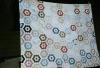
Patchwork quilt of hexagons in 'Grandmother's Flower Garden' pattern, consisting of a dark centre hexagon, a row of light patches, then a second row of dark patches in the same colour as the centre. Each group of patches or 'flower' is joined by white paths. Colours are predominantly red, blue, brown and pale or faded colours. Some fading; some dark colour fabrics have deteriorated. Backing. Hand sewn. Border of quilt and backing sewn edge to edge.
2236 x 1829mm
2236 x 1829mm

Quilt with centre area of silk triangles framed with small squares and the rest of the top is larger squares. Wide variety of prints and plain materials. There is no padding. The backing is cotton and "E.M.B." is cross stitched in one corner. "Back is interesting as it's all the same fabric, joined but it appears to have been stitched with a running stitch (cf quilting) before it was attached to the front. It was definitely done after being joined as the stitching design follows through the seams." [Fran Williams]
2500 x 2500mm
2500 x 2500mm

Cotton quilt of hexagons in 'Grandmother's Flower Garden' pattern. Hand stitched. Machined to a cotton backing. There is no padding.
2480 x 1950mm
2480 x 1950mm
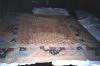
Frame quilt in cottons with a centre motif of pieced 8 point star surrounded by borders, 2 from red/white material printed to represent Tumbling Block patchwork. The remaining borders are, one plain, one of pieced squares, one of pieced large triangles with squares in the corner. The outer border is plain. The padding is wool and the backing is cream cotton. It is elaborately quilted.
2400 x 2260mm
2400 x 2260mm
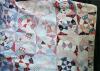
Block pattern consisting of a circle, hexagon and circle within a square. Cotton dressmaking fabrics with a few plain creams. Hand pieced and hand quilted. At some stage has been machine reinforced. Now faded, worn and damaged especially one end. Quilting pattern is four leaf clover inside large cable. The backing is 4 different pink toned fabrics in longitudinal stripes. Cotton batting. 2620 x 2300mm
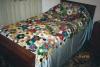
Grandmother's Flower Garden, also known as French Bouquet. The quilt comprises 181 flowers. No padding is used. Each flower has seven hexagonal patches, cut from a metal template pattern. Floral and plain silk materials are used and mounted on pale blue moire taffeta.
3050 x 2031mm
3050 x 2031mm