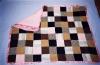
Quilt No.786CN - Charlotte Nattey

Charlotte Nattey
Owner: 
Charlotte Nattey
Location: 
ACT
Maker
Maker: 
Mildred Millington
Made in
ENGLAND London
Date: 
1941 - 1970
Description: 
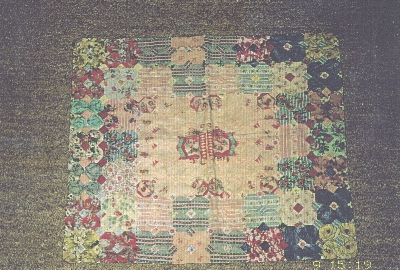
Cotton quilt of pieced hexagons and some diamonds made for a baby's basket. Colours are mainly blue and pink and two 'Punch and Judy's' are appliqued in the centre. There is no padding and the backing is a cotton floral in blues and greens.
760 x 660mm
History: 

The quilt was made in London by Miss Mildred Millington in 1966 for the birth of the first child of her niece Charlotte Nattey who still owns it. It is stored for the next generation.

Story: 

" To tell you of the quilt is to tell you of the person.
My aunt joined the ATS in 1938. She felt war was inevitable and wanted to do something practical. She became an officer in charge of an 'Ack Ack' battery that fired the first shots in the defence of London. In 1944 she was one of a very small detachment of women (all part of the 'Ack Ack') who were stationed in Belgium with the aim of shooting down V1 and V2 bombers. I believe these were the only women on active duty for the allies in Europe.
After the war ended she remained in the army - now the WRAC rising to the rank of Lieutenant Colonel before retiring in 1956.
She then held a position with the army benevolent fund. This quilt went with her to 'keep her busy' on many postings.
Finally I should tell you that although right handed she had an accident when she was about 10 and had to always use her left hand. She also had poor eyesight due to childhood cataracts so the fact that she always knitted and did tapestries and quilts was quite remarkable."
[Charlotte Nattey 6.4.97]
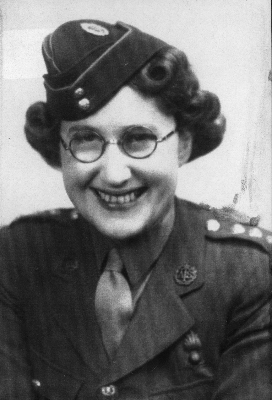
Mildred Millington
Mildred Millington

Related Quilts:

Gillian Sullivan
Quilt made of 9120 very small Suffolk Puffs, each one about the size of a 20 cent piece. "Each piece backed and the front of it drawn up like a reticule. It was not backed and was rather fragile, so I backed it on to a sheet, as it was heavy and in danger of tearing when lifted." [Gillian Sullivan]
2360 x 2230 mm
Tricia Bowdler
Small patchwork piece in crazy patchwork in silks, satins, and velvets. Embroidered initials 'A.N' also an embroidered crest, the date 1869 with initials 'A.W.N'. There is also decorative stitching over the joins of most pieces. It is not padded. The backing is Jacquard.
661 a 649mm
Wendy McPhail
Repeat block in Ohio star pattern. Wide border of triangles, pieced blocks and stripes. Stars are in greens, pinks, mauves (all now very faded) and white. Wreath quilting in squares with smaller wreath quilting in triangles. There is padding and the backing is a poly/cotton sheet. 2500 x 2450mm
National Gallery of Australia
" A wide range of cotton fabrics have been used to make this quilt in the traditional log cabin style. The strips of the log cabin are joined by rows being hand sewn onto a small square backing fabric, each square of strips has then been hand sewn together to form the quilt. The work is backed with a sateen printed fabric decorated with paisley design. A strip of the lining trims the edge of the front face of the quilt. The lining is attached with machine stitching. There are numerous tacking stitches that remain in the front face of the quilt. There are approx 9000 pieces in the quilt, most being only 5mm in width.
The quilt is of three layers because the strips of the log cabin are attached to a backing piece, and then the quilt is lined; however it is not padded." [NGA]
Fran Williams
Crazy quilt made from a lot of light wools including gabardine types. Patches are outlined in embroidery stitches and there is additional embroidery on some patches. It is worked in 3 ply wool thought to be Patonyle (early blend of nylon and wool). The backing is a floral print mainly black with a cream flowers, brought to the front as a binding. Occasional stitches holding front to back by way of quilting. There is no padding.
1600 x 2100mm
Dubbo Museum & Historical Society Inc
"English patchwork pieces. 1110mm x 1500mm. Hand pieced by at least two people. Made from scraps, cut down clothing and sheeting. Backing made from shirtings, dress fabrics, furnishing fabric and ticking. No synthetics. Machine quilted. Condition, fragile�.." [Dubbo Museum]