
Quilt No.884NTNW - National Trust of Australia (NSW)
Description:
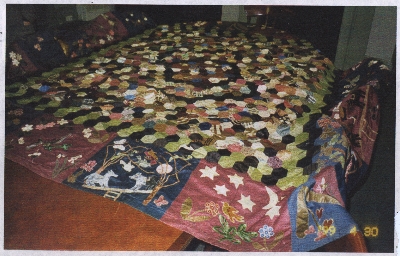
The body of this quilt is hexagons. This centre piece is surrounded by an applique border of birds and flowers and donkeys on see-saws. The flowers have been elaborately pieced from a great variety of materials. Some of the birds have pres studs for eyes.
History:
The quilt was made by Charlotte Housley in England probably about 1850. It came to Australia in 1989 and was donated to the National Trust in 1999 by Bob and Cynthia Brooks. It is now in the National Trust (NSW) collection.
Story:
Charlotte Housey (the maker) was Mrs. Brooks' (the donor) great-great aunt. Mrs. Brooks mother was born in 1911. Emma Housley was Charlotte's daughter. The machine stitching was done by Emma after Charlotte's death. The quilt came to Australia in 1989 with Mrs. Brooks after her mother's death. A second quilt existed but was thrown out by a family member years ago.
Related Quilts:
The quilt consists of 2 layers of random pieces of woollen coating and suiting materials machined together, very dark colours on one side and a mixture of dark and lighter on the other. The 2 layers are quilted together with a row of machining and has a folded and machine stitched edge. There is no padding.
1270 x 950mm
1270 x 950mm

Cotton patchwork quilt in an all over pattern of diamonds in a wide variety of patterned and plain materials. Many seams are oversewn in feather stitch which goes through to the backing of calico.
1625 x 925mm
1625 x 925mm
Quilt made of hexagons in cotton materials, the hexagons set in the 'Grandmother's Flower Garden' pattern with 6 patterned patches set around a plain coloured centre patch and white hexagons forming 'paths'. There is a white cotton backing with the edges turned under all the way around and top and backing are joined by a blue machine sewn satin stitch. The patches are hand sewn.
2160 x 1830mm
2160 x 1830mm
Cotton quilt made from squares of patterned and plain materials. It has a mauve cotton flounce around the border and a mauve cotton backing. There is no padding.
2700 x 1350mm
2700 x 1350mm
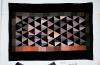
"A tied patchwork wagga quilt made from swatches of men's wool suiting fabrics in blue/grey and pink/brown tonings. Rectangular swatches have been cut in half diagonally, and the resulting right-angled triangles paired to form larger equilateral triangles which alternate dark with light across the field. The quilt has been machine and hand pieced, then machined in vertical stripes.
The centre field is bounded by two strip-pieced borders at top and bottom, and three down each side. These are sewn from rectangles, using light pink/brown tones for the inner border and darker colours for the outer borders. The quilt is padded and backed and the side seams are secured with black herringbone stitch. The three layers are tied together invisibly with lazy daisy stitches in black cotton from the back." [PHM] The padding is a wool blanket and the backing is two pieces of cream twill cotton.
2030 x 1440mm
The centre field is bounded by two strip-pieced borders at top and bottom, and three down each side. These are sewn from rectangles, using light pink/brown tones for the inner border and darker colours for the outer borders. The quilt is padded and backed and the side seams are secured with black herringbone stitch. The three layers are tied together invisibly with lazy daisy stitches in black cotton from the back." [PHM] The padding is a wool blanket and the backing is two pieces of cream twill cotton.
2030 x 1440mm
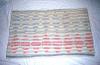
The quilt is constructed from machine pieced diamond shaped striped flannel materials. The backing is the same. The padding is not visible but is thought to be worn out woollen clothing, unpicked and ironed flat.
1520 x 970mm
1520 x 970mm