Quilt No.924CP - Connie Papalazaros

Connie Papalazaros
Owner: 
Connie Papalazaros
Location: 
QLD Brisbane
Maker
Maker: 
Panagioti Zoumbatli
Made in
AUSTRALIA NSW
Date: 
1941 - 1970
Description: 
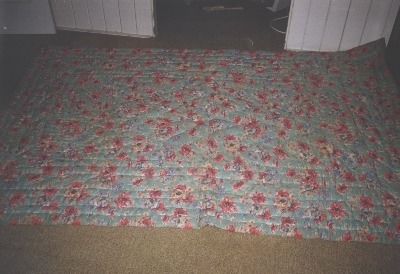
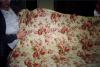
Wholecloth quilt made from floral cotton material with a light green background. Hand stitched quilting pattern of diamonds in the centre and parallel lines radiating out from this. The padding is cotton wadding.
1940 x 1300mm
History: 

The quilt was made in Sydney by the quiltmaker Panagioti Zoumbatli c.1950. It was ordered by Evdokia (Eve) Kiossoglou for her daughter's 'prika' (dowry or trousseau). Her daughter Connie Papalazaros has always been the owner.

Story: 

"Connie's Two Quilts
While Connie Papalazaros was still quite young, her mother Evdokia (Eve) began assembling a 'prika' (dowry or trousseau) for her daughter, in preparation for getting married. Evdokia was being true to her Kastellorizian origins - her daughter's prika would not be complete without at least one 'paploma' (quilt) She ordered these two quilts from Panagioti Zoumbatli a Sydney-based 'paplomatas' (quilt-maker). He, like Connie's parents, had migrated from the tiny Greek island of Kastellorizo.
Evdokia Kiossoglou came to Australia in 1935, married Agapitos (Peter) Pengly in the north Queensland town of Innisfail, just at the time that the Greek Orthodox Church was being established there. They had four children: Connie, Pauline, Thaao, and George. Soon after Connie was born, the family moved to Sydney and lived first in Surry Hills and later in Kingsford, which has always been a popular 'Greek' suburb of Sydney. 'Mum used to walk to the Cassie Club!' Connie recalls. Sydney's well known Castellorizian Club has played an important role in the life of the city's Greek Australian community.
Connie eventually returned to Brisbane (taking her 'prika', of course!) and married John, who had migrated from Kastellorizo in 1950. As with so many other Greek-Australian women in Queensland, Connie started off using her quilts, but the hotter climate meant that they were eventually replaced by lighter bedcovers. Connie and John have always owned their own snack bar business, and their traditioinal 'Queenslander' house where they still are today."
[Written by Lula Saunders, adapted from interview 6/9/00 for the National Quilt Register]
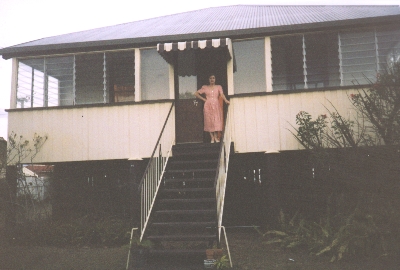
Connie Papalazaros at her Brisbane house, 2000

Related Quilts:

Yvonne Hamdorf
Wholecloth pram quilt with a top of pink cotton sateen, and the reverse is a more finely woven, ivory, fabric. All over quilting design as main feature, with stylised hearts, leaves and cross hatching. The padding is cotton batting. 870 x 660 mm.
John Tomkin
Hand stitched, cotton, appliquéd, quilt in a flower pattern on a plain background. Colours are shades of green, apricot and browns. This quilt was known as a 'Bride's Quilt'. Padding is thought to be layers of white fabric raised almost like a wadding. The backing is cotton material. 2470 x 2020 mm.
Maria Alexakis
Wholecloth quilt. Quilting pattern is a large 'feathered thistle' with thick stem, as the main design feature. The border is a combination of straight and curved parallel lines. Burgundy sateen with damask weave. All quilting is handstitched. Padding is cotton wadding and backing is tomato red cotton. 2150 x 1820 mm.
Margaret Lyons
Padding for a utilitarian quilt that originally had a wholecloth cover. The padding is up to 3 layers of woollen scraps and pieces of used clothing, including hand knitting. White cotton tacking and overcast stitches hold all layers in place. The backing is a cream wool blanket with woven stripes.
1580 x 1200mm
Ida Blenkiron
Wholecloth cot quilt of floral cotton in a pattern of pink roses, green leaves, and blue ribbons. Paddiong is old blanketing, and backing is a soft fawn twill. The cotton was the same fabric as the bedroom curtains. No quilting.
1010 x 840mm
Denise Frahn
Wholecloth quilt, machine sewn, made from cotton chintz with a pale green background and a floral pattern of bunches of pink roses and blue flowers, reversible. The centre is stitched in a diamond pattern with two outside borders, then filled with feathers, using a broom handle to force the feathers through. Cover made from 36" fabric, the pattern matched exactly. Excellent condition. Feather filling was collected by the makers from backyard poultry, geese, ducks, fowls. Called an eiderdown.
1830 x 1480mm