
Quilt No.1020GC - Gabrielle Carter
Owner:
Gabrielle Carter
Location:
WA Perth
Maker
Maker:
Margaret Laidlaw
Made in
USA New York
Patterms
Date:
1881 - 1900
Description:
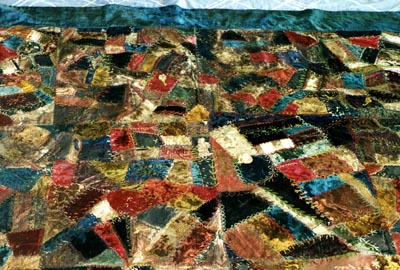
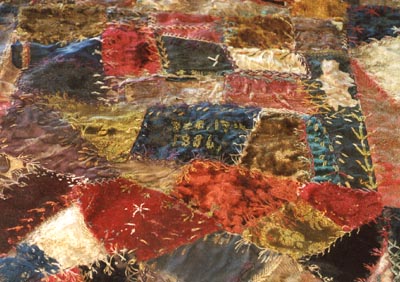
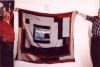
Crazy quilt of velvet upholstery fabrics, and cigar ribbons with surface embroidery. Patches are outlined in embroidery stitches, and one patch has 'Dec 12 1886' on it. There is no padding, and the backing is cotton. 1720 x 1580 mm.
History:
Made in 1886, by Margaret Laidlaw of Mt St Vincent, New York. She married Ernest Sturridge, a dental surgeon of Mandeville, Jamaica. They had six children. She moved to London England in 1897, and to Jamaica in 1932, and died in 1952 in Sussex UK. The quilt was then owned by Dr and Mrs Francis Sturridge, Hampstead,UK; and Dr and Mrs Jerome Sturridge, Harley Street, London. The quilt was brought to Australia in 1996, and is owned by Margaret Laidlow's great grand-daughter. Quilt is not used.
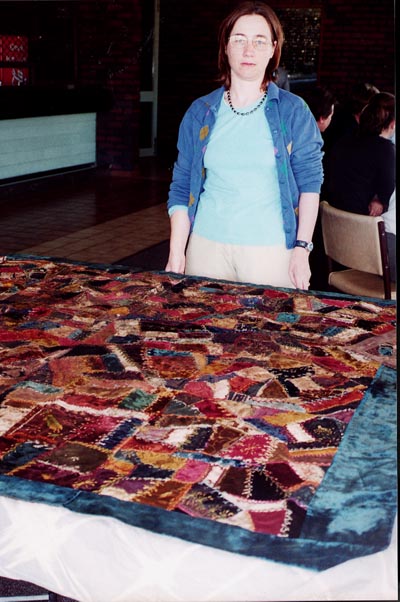
Gabrielle Carter with quilt
Related Quilts:
Patchwork quilt of multi coloured silks and brocades. Crazy patchwork borders, mainly rectangular fabrics pieced together in diagonal patterns, radiating from a central frame embroidered with flowers. Many pieces are extensively embroidered in a great variety of stitches and motifs; butterflies, sunflowers, cats, daffodils, crown, pawn broker's symbol, 'money to lend', 'good night', the initials of family members and 'mater 1890'. The quilt has a deep border of maroon sateen. There is no padding visible but it is possibly a blanket. The backing is green/gold silk with a self stripe with red cotton damask showing underneath, possibly an earlier backing.
2165 x 2165mm
2165 x 2165mm
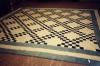
Cotton quilt made in the USA. The pattern is 'Double Irish Chain'. It is machine pieced and hand quilted. The backing is calico and the padding is cotton,
2134 x 2134mm
2134 x 2134mm
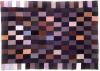
" Reversible patchwork quilt of woollen suiting/upholstery fabrics in khaki, greys, blues and browns. Both sides have different designs. The front of the quilt has 13 rows of 12 vertical rectangles flanked on either side by a column of 22 horizontal rectangles. The reverse has a more interesting and complex design of small and very large rectangles, squares and triangles; with khaki contrasting with the duller greys and blues. The patchwork layers are joined at the edges with machine stitching and the quilt is machine quilted along 3 horizontal lines following joins in the patchwork; therefore not being totally straight. These lines are more noticeable on the reverse. The reverse face has been on display at the NGA." [NGA] There is a cotton blanket used as padding. 2054 x 1451mm
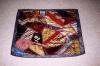
Small patchwork piece in crazy patchwork in silks, satins, and velvets. Embroidered initials 'A.N' also an embroidered crest, the date 1869 with initials 'A.W.N'. There is also decorative stitching over the joins of most pieces. It is not padded. The backing is Jacquard.
661 a 649mm
661 a 649mm
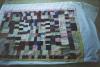
Hand pieced cot quilt made from small rectangular shapes of a great variety of materials including cottons, silks, wools and velvets. The backing is cotton sateen in 3 colours and is brought to the front to form a border of pink, cream and yellow.
1170 x 920mm
1170 x 920mm
Double sided frame quilt. All reused materials including corduroys, wools and light weight suitings. Machine made and not quilted There is no padding as already heavy and warm.
1780 x 1530mm
1780 x 1530mm