Quilt No.13JHS - Junee & District Historical Society
Junee & District Historical Society
Owner: 
Junee & District Historical Society
Location: 
NSW Riverina
Maker
Maker: 
Amelia Cuttle
Made in
ENGLAND
Date: 
1851 - 1880
Description: 
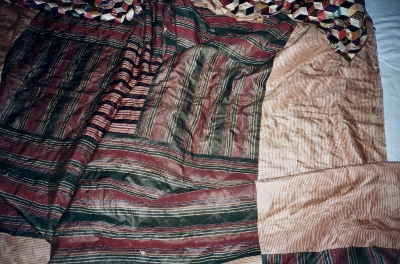
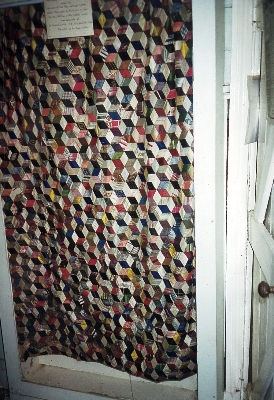
Pure silk hand sewn Tumbling Block quilt incorporating a great variety of silks in plains, florals and stripes. The backing is large rectangles of striped silks or polished cottons. It is hand quilted in a simple square cross hatch.
790 x 1470mm
History: 

The quilt was made in England by Amelia, the wife of the Reverend William Cuttle before they came to Australia. The Rev. William and Mrs Cuttle were grandparents of Dr. Ronald Cuttle. His wife Mrs Ronald Cuttle donated the quilt to the Junee and District Historical Society NSW.

Story: 

Label reads: 'Hand made box pattern patchwork quilt. Made in England by the wife of the Reverend William Cuttle before they came to Australia in 1884. The Rev. William and Mrs Cuttle were grandparents of Dr Ronald Cuttle M.B. B.S. (Melb) FRCS. Presented by Mrs Ronald Cuttle.'
"Enclosed is a photo of a Quilt which we have always believed came to Australia in March 1863 with my great grandparents - Rev William & Mrs Amelia Cuttle. Whether she made it on the way out, or had made it before she left, we are not sure. Unfortunately some parts of it have begun to deteriorate - it is made from mostly silk materials. Some years ago my mother gave it to the Junee Museum where it's displayed in a glass case which my mother provided for its protection. �..Rev William Cuttle came out from the Whitfield Tabernacle Congregational Church, Kingswood Bristol, to be minister of the Geelong (Vic) Congregational Church in 1863."
[Letter from Anne Carter, 1996]

Related Quilts:
Annette Gero
This domestic Wagga is two layers of woollen army blankets with the top layer in rectangles joined in rows. The backing is hessian bags that originally contained meat meal.
11650 x 1130mm
Fran Williams
Quilt with centre area of silk triangles framed with small squares and the rest of the top is larger squares. Wide variety of prints and plain materials. There is no padding. The backing is cotton and "E.M.B." is cross stitched in one corner. "Back is interesting as it's all the same fabric, joined but it appears to have been stitched with a running stitch (cf quilting) before it was attached to the front. It was definitely done after being joined as the stitching design follows through the seams." [Fran Williams]
2500 x 2500mm
National Trust of Australia (SA)
Double bed patchwork coverlet of pieced blocks in a pinwheel or dresden plate pattern of prints on a cream ground, each block with a 1 3/4" border or sash. Each pinwheel has 10 pieces, and the quilt is constructed 8 blocks by 6. Cotton fabrics are in florals, checks and stripes, in blues, greens browns, pinks, purple. The quilt was in poor repair and has been reduced in size. Conservation work has been done by the State Conservation Centre.
Backing or filling unknown.
The Pioneer Women's Hut
Single bed quilt made up entirely of hexagons in 'Granny's Flower Garden' pattern. The rosettes are made up of 8 hexagons and a central one. Native flower prints, including wattle, on a white background. Plain hexagons in white, yellow and blue form a scalloped border. Hexagons are hand stitched and the 2 layers are quilted in running stitch. The backing is a pieced sheet.
2400 x 1500mm
Barbara Levy
"The quilt is made up of many cotton hexagons of various colours, patterns and designs, finely sewn by hand, making a very attractive bedspread. Each patch is lined with lawn. It is quite a heavy quilt, with its plain border, and backing of home-spun cotton or cesarine. The family always called it a 'cottage design'."
No quilting.
2312 x 1905mm
Robyn Gallaway
Machine made cotton quilt with 100mm cotton squares placed diagonally with peaks running around the edge. The colours are mainly autiumn tones and the patterns include checks, tartans, florals, geometric and plains. Materials were scraps left over from sewing projects such as children's clothes. There is a matching valance.