Quilt No.183AHS - Arapiles Historical Society Museum
Arapiles Historical Society Museum
Owner: 
Arapiles Historical Society Museum
Location: 
VIC North West
Maker
Maker: 
Mary Keyte
Made in
AUSTRALIA VIC
Date: 
1881 - 1900
Description: 
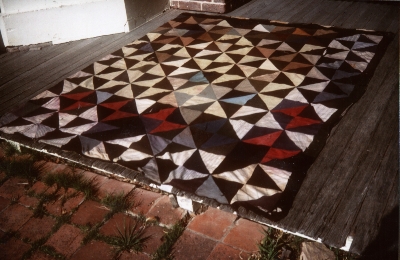
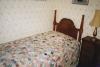
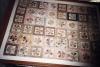
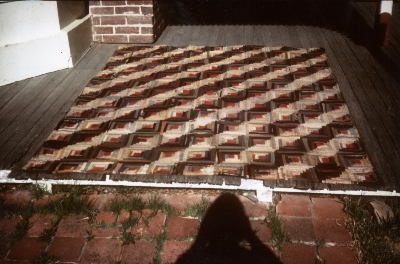
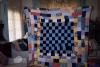
Patchwork quilt, reversible, with log cabin blocks on one side, with central red square in each block. Colours predominantly light greys, browns and pastels, and dark grey and blue. Reverse side is made of squares constructed from 2 triangles, in black, patterned pastels, pale blue and dark red. There is a black border along 2 edges on this side. It is quilted.
2058 x 1829mm
History: 

Made by Mrs Mary Keyte in the Natimuk area (VIC) in the 1880s. Handed down through the Keyte Families, now owned by the Arapiles Historical Society.

Story: 

Letter from Arapiles Historical Society:
"Mrs Mary Keyte made the quilt from hand me down clothes, and any scraps she was able to collect, mostly used materials. Mrs Mary Keyte passed away on 23-3-19 at the great age of 95 years. A typical English woman she was born at Harbury England 1819, and came to Australia with her husband in 1855, landing at Adelaide, and settling later at McLaren Vale. They came to the Natimuk area in 1872, when most of the early settlers arrived. Her husband conducted a Blacksmith Shop. He died two years after their arrival, so she went to reside with her son Charles, and stayed there until her death. As we can see, Mary was an industrious woman, and could turn her hand to anything., as she would need to be thrifty in that era.
She and her husband are both buried int eh Natimuk Cemetery. Keyte in our area is pronounced at (Keet) Jennifer on TV has a different pronunciation pronounced as (Kyte).
The Keyte families still live in this area. They were highly respected residents, and were ever willing to give a hand where needed.
Mr Keyte had other brotherand sisters, and these folk farmed their land successfully. Mrs Keyte regularly visited Natimuk until 2 or 3 months prior to her death. �"

Related Quilts:
Rozanne Andrew
Patchwork crazy quilt of late 40s and early 50s. Pieces are from curtains, tablecloth,other kitchen type fabrics in cotton, seersucker and linen. Colours are mainly reds, greens, blues, and pastels, in prints and plain. Herringbone stitch is worked around the edge of each patch. No filling. The backing is calico with one edge in a piece of coloured cotton from the front; the calico was a little small for the top.
2020 x 1400mm
Art Gallery of South Australia
Rectangular patchwork crazy quilt pieced in squares (3 across by 4 down), in silks and wool, with red sashing between blocks and red border, quilted. Colours are dark, with red and light blue. Embroidery includes double feather, rope, herringbone, satin, cross, sword edge, buttonhole and coral stitches, and French knots. Embroidered flowers include lily of the valley, rose, daisy, and sunflower, also butterflies. Backing is pieced in the frame style, with a large centre red square, within 10 frames or borders. Embroidered "In Most Loving Memory of My Darling 1883", "V.H.B." Hand sewn.
1900 x 1500mm
Joyce Lannin
A hand sewn quilt of more than 6,536 hexagon pieces in cottons, silks and polyester mix. There is a centre circular pattern of hexagons within a larger hexagon and small hexagons form larger hexagons in a random pattern on the quilt top. There is no padding and the backing is a plain fawn sheet with a floral edging in hexagons. 2880 x 2550 mm.
Jan Tregoweth
Square patchwork quilt made from rectangles of woollen tailors' samples, each patch outlined with machine fancy stitch using red thread. Machine sewn. The backing is a green and white check fabric. No filling.
Mare Carter
Patchwork quilt, all cotton including cotton padding. Pattern is based on squares and a cross. Variety of fabrics, plain and patterned. Hand stitched and quilted.
2083 x 1626mm
National Trust of Australia (NSW)
The body of this quilt is hexagons. This centre piece is surrounded by an applique border of birds and flowers and donkeys on see-saws. The flowers have been elaborately pieced from a great variety of materials. Some of the birds have pres studs for eyes.