
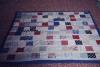
Quilt No.43JP - Julie Pearce
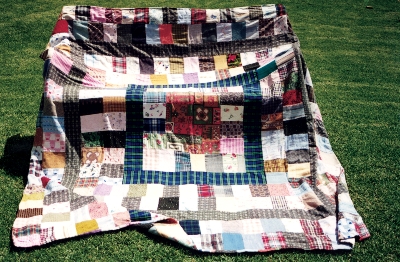
cottons pieced in squares and rectangles within 2 frames, the inner border or frame of blue/green check material, then 2 rows of squares and rectangles, the outer frame of a grey and red geometric pattern and 2 rows of squares or rectangles. Backing of plain fabric. Machine stitched on a treadle machine.
Made by Elizabeth Louise Williams (Nana), great-grandmother of Julie Pearce, in the 1960s, for Julie and her sister. Owned by Julie Pearce and used on her children's beds in Thirroul, NSW.
"My paternal great-Grandmother � was a keen sewer in her time and over 30 years ago made my sister and myself a functional quilt for our beds. She made them on her treadle machine and used fabric scraps that my mother had left over from clothing that she herself had made for us. As a child I clearly remember lying on my bed reminiscing over favourite fabrics and special dresses and reliving memories of times and places the dresses were worn. The time spent on those quilts was well appreciated and is still admired as my children now learn the stories behind the quilts I treasured when I was much younger than they both are now. I am so thrilled they are wiling and happy to share these quilts which mean so much to me.
My Great-Grandmother, Elizabeth (Nana) Williams of Canterbury, Sydney throughout her many productive years, kept herself busy with her sewing. No doubt having eight boys, she had little need to sew pretty dresses so put her skills and time to an equally practical use. She regularly made quilts, at times using fabric supplied to her by The Smith Family, which upon completion she donated to the Aboriginal Missions. Some quilts were used by other family members � I can clearly remember several other quilts of hers that I have seen, one using black imitation fur strategically cut and placed to use the play of light as its feature, another, crazy patchwork squares adorned with feather stitch. � Nana Williams made perhaps hundreds of quilts in her time, which she mostly gave away. She lived a very frugal lifestyle herself and lived to be well into her eighties when she was still actively sewing.
I estimate the quilts I have were made very early in the 60s although these particular 2 would have been nana's most recent."
[Julie Pearce 20.2.98]
Related Quilts:
1400 x 400mm

1620 x 1595mm
1651 x 1220mm
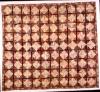
The quilt is of three layers because the strips of the log cabin are attached to a backing piece, and then the quilt is lined; however it is not padded." [NGA]

The work is not padded "The lining at the edge of the quilt (for approx.175mm) is a plain weave fabric of a Chinoiserie design. The centre field of the lining is a rectangular panel of a twill weave brushed cotton fabric with a striped floral design." [NGA] 2215 x 2070mm
1626 x 1601mm