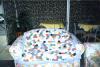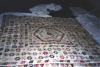
Quilt No.550PD - Phyllis Dowling

Phyllis Dowling
Owner: 
Phyllis Dowling
Location: 
NSW Riverina
Maker
Maker: 
Harriet Harris?
Made in
AUSTRALIA NSW
Date: 
1851 - 1880
Description: 
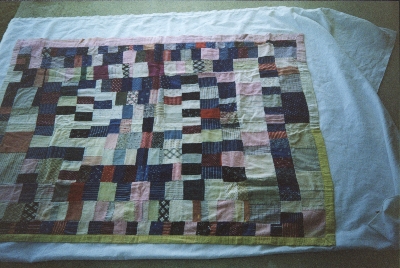
Hand pieced cot quilt made from small rectangular shapes of a great variety of materials including cottons, silks, wools and velvets. The backing is cotton sateen in 3 colours and is brought to the front to form a border of pink, cream and yellow.
1170 x 920mm
History: 

The exact history of the quilt is not known but it is thought to have been made by Harriet Harris at either Kiandra or 'Glory Hole' in the 1860s. It is now owned by her great grand-daughter, Phyllis Dowling.

Story: 

"Harriet Harris was born c.1825-1830 in Pedwell, Somerset, England. She was the daughter of John Chapple, a builder, and Mary Sandy. She married Henry Josiah Harris on 2 January 1853 at Trinity Church, Newington, London.
Henry Harris was a butcher and had several trips to Australia as a Ships Butcher before deciding to remain here c.1857.
They had 3 children born in London, Annie, Emma Harriet and Henry George. Harriet and her 3 children arrived in Sydney on the ship 'Herald of the Morning' on 25 June 1858. The family were in Newtown, Sydney when the 4th child, Robert, was born 6th June 1859.
In 1860, following the discovery of gold the family moved to Kiandra, travelling to Twofold Bay by boat and then to Kiandra by bullock dray.
The next child, Catherine Louisa was born there 9 May 1860 followed by Rose Elizabeth 12 September 1864 and finally Oliver John 9 February 1866.
Henry Harris continued with his butchering business in Kiandra but because of the harsh winters had to have somewhere other than Kiandra for his stock in winter so besides the home in Kiandra he purchased a 40 acre block below what is now Yarrangobilly Caves. This property was called 'Glory Hole' and members of the family lived there until 1910.
Although small and primitive in the beginning the 'Glory Hole' home eventually had 5 bedrooms, lounge, dining room, kitchen. hallway and verandah. The house was built of timber split on site.
Both Henry and Harriet are buried in the family grave at 'Glory Hole'. Henry died 17 August 1898 and Harriet 1 August 1904."
[Phyllis Dowling, Tumut 1998]
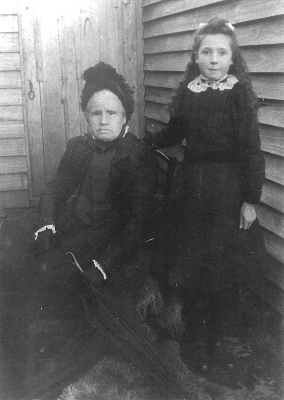
Harriet Harris with g.daughter Alice West, Glory Hole 1902

Related Quilts:

Annette Gero
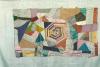
Hand pieced frame quilt with centre frame of hexagons and radiating borders of cotton and chintz. There is a heart at each of the 4 corners on the second border. It is hand quilted. There is no padding.
1900 x 1900mm
National Trust of Australia (TAS)
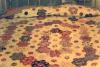
Patchwork quilt of cotton hexagons in a random mix of colours and prints, the predominant colours being blue, red, green, light yellow and pastels. Patches hand sewn. There is no padding and the backing is a grey wool blanket. The top is machine stitched around the edge to the blanket.
1645 x 1060mm
Roslyn Beattie
Patchwork quilt made from different sized rectangles, in new materials, including cotton, lightweight velvet, lining silk, crepe, seersucker, and satin. All fabrics are of even weight. Colours are mainly light, with pinks, greens and blues predominating. No padding or backing. Quilt was not finished.
2050 x 1250mm
Pioneer Settlement Authority
Cot quilt of cotton hexagons. There is a central diamond of hexagons and then a repeat diamond motif radiating to the edge. Each hexagon is 40mm. The backing is sheeting or similar and the padding is dacron type.
1200 x 700mm
N.S.W. Parks and Wildlife Service
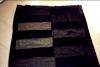
Large double sided quilt of rectangles and squares of men's suitings, patterned and plain on both sides. The top has a central motif of a circle of three segmented rings radiating from a single hexagon. The outer ring is all tailors' samples and the inner rings are a variety of materials. There is some featherstitching in red. The quilt is sparsley machine quilted.
Thelma Lithgow
Repeat block quilt top based on hexagons, each 350 mm diameter. Six hexagons and a centre one make a 'flower' and these are set in rows against a plain calico background. Patterned cotton fabrics are used for the hexagons, small prints, fine stripes and tiny flowers. As it is a quilt top only, there is no lining or padding. 2100 x 1800 mm