Quilt No.463JB - June Brown

June Brown
Owner: 
June Brown
Location: 
VIC North East
Maker
Maker: 
Annie Hulland
Made in
AUSTRALIA VIC
Date: 
1941 - 1970
Description: 
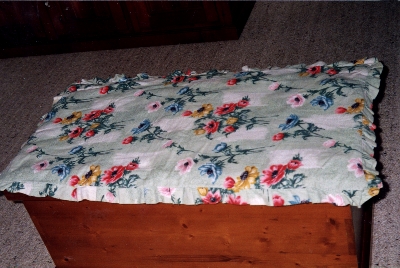
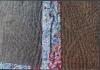
Rectangular cot quilt of green floral cretonne with pleated frill. Machine made. The backing is the same material. It is tied not quilted. The padding is old woollen jumpers.
1050 x 610mm
History: 

The quilt was made by Annie Hulland in 1957 for her first grandon Andrew. It was then used by her daughter, Heather McClounan, for the other 3 children. They lived on a farm at Hopetoun, Victoria. Heather McClounan gave the quilt to June Brown in 1998 to care for and use as an historical record. It is not used now and is stored in a cotton bag in a cupboard in June Brown's home.

Story: 

The material was originally purchased to make curtains but was used to make this functional cot quilt instead. Heather McClounan said of her mother: "My mother was a very thrifty person, as there were five children in our family, born between 1929 and 1939. I fancy it (the quilt) was necessity. She made this quilt for my son Andrew and it was subsequently used for my other three children." [Heather McClunan]

Related Quilts:
Yvonne Hamdorf
Wholecloth pram quilt with a top of pink cotton sateen, and the reverse is a more finely woven, ivory, fabric. All over quilting design as main feature, with stylised hearts, leaves and cross hatching. The padding is cotton batting. 870 x 660 mm.
John Tomkin
Hand stitched, cotton, appliquéd, quilt in a flower pattern on a plain background. Colours are shades of green, apricot and browns. This quilt was known as a 'Bride's Quilt'. Padding is thought to be layers of white fabric raised almost like a wadding. The backing is cotton material. 2470 x 2020 mm.
Margaret Wilson
Hand stitched appliqued quilt or banner. Different hand stitching indicates applique was probably done by several people. There is no padding. The backing is calico.
2230 x 2140mm
National Gallery of Australia
" Reversible patchwork quilt of woollen suiting in grey, blue, navy, maroon and brown. The fabrics appear to be new tailor's sample pieces (the sizing is still present on the fabric, signifying it has never been washed). The patches are rectangular and vary in size. Both sides have different designs. The front of the quilt has 4 rows of 12 vertical rectangles then below this are 4 rows of 7 horizontal rectangles followed below by 4 rows of 11 vertical rectangles. The reverse of the quilt has a section at the top and bottom composed of 5 rows of 9 horizontal rectangles. The central area is made up of a centre section of 6 rows of 5 vertical rectangles; flanked on either side by a column of 10 horizontal rectangles and two columns of 8 smaller vertical rectangles.
The patchwork layers are joined at the edges with machine stitching. The patchwork layers and padding are machine quilted on the front down 2 vertical lines following joins in the patchwork; therefore not being totally straight. The lines are more noticeable on the reverse as the 2 sides do not match. The front face is displayed at the NGA.
Between the patchwork layers is a striped cotton blanket in black, sky blue, white and cream." [NGA]
2082 x 1386mm
Nancy Stinson
The padding consists of layers of pieced used clothing including; part of machine knitted child's wool dress (Nancy had this when she was 3 or 4); part of father's cardigan; parts of 'neck to knee' bathers in light green and dark green wool. The padding is all hand pieced and machined around the edge. There have been 2 wholecloth cotton covers to this quilt. It is one of a pair.
1870 x 1020mm
Kereake Wray
Wholecloth Greek quilt. "The fabric is a beautiful silk satin with a formal pattern of soft yellows and pinks on a turquoise background. Surrounding this is a 40cm wide border also of silk satin (cerise coloured). The quilt is machine pieced but hand quilted. The method of quilting is very interesting. A thick cream twist has been used and at first glance it seems that the quilt is tied as there are long pairs of stitches with gaps of about 4cm between them. However, either a long needle was used to make a pair of stitches OR each side may have been quilted separately with the needle only going half way into the wadding which is about 2 cms thick." [Kereake Wray] The padding is kapok approx 2 cm thick and the backing is deep coral pink satin. 2200 x 1960 mm.