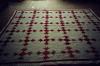
Quilt No.562NPW - N.S.W. Parks and Wildlife Service
N.S.W. Parks and Wildlife Service
Owner: 
N.S.W. Parks and Wildlife Service
Location: 
NSW Sydney
Maker
Maker: 
Sarah Marshall?
Made in
AUSTRALIA NSW Central West
Date: 
1921 - 1940
Description: 
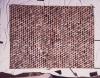
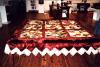
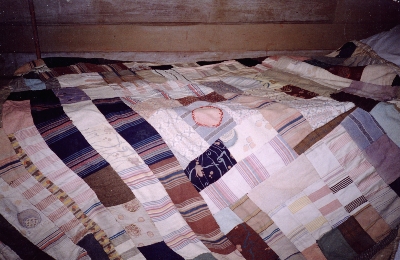
Crazy patchwork on to foundation material with the edges of the pieces turned under and machined. It is not quilted. A 25mm red binding has been machined on. There is no padding. The backing is red wholecloth cotton.
1940 x 1540mm
History: 

At this time it is impossible to make a definite attribution to Sarah Marshall but this quilt was almost certainly made by Sarah Marshall and/or one of her daughters, Hannah, Jean or Agnes at Hill End NSW and probably at 'Craigmoor' their family home. The exact date is unknown. It is now part of the 'Craigmoor' collection owned by the NSW National Parks and Wildlife Service and displayed at 'Craigmoor'.

Story: 

James Marshall (1828-1905) from Scotland via the Californian gold rush and Sarah Langslow Adams (1836-1926) born Herefordshire England, were married in 1858 at Hill End. Reef mining in the 1860s brought fame and fortune to this mining settlement, north of Sofala and Bathurst in NSW.
In 1875 James Marshall had 'Craigmoor' built and he and Sarah lived there with their family of 9 children, 2 having died in infancy.
The textile collection at 'Craigmoor', including the quilts, reflects the Marshall women, Sarah and her daughters Hannah (1859-1950), Jean (1867-1948) and Agnes (1871-1950) and gives a glimpse of the daily lives of the women. Needlework, including crochet, in various forms was important and some of the women made their own hats. At least in the later years it appears to have been a thrify household with many quilts made over and patched.
Hannah, a spinster, lived at 'Craigmoor' from the time it was built until her death aged 91. She taught Sunday school in Hill End and was well know locally for her bottling, preserving and jam making. She also made elderberry wine. The 3 sisters were fond of playing the piano.

[Sources: N.S.W National Parks and Wildlife Service brochure on Hill End, Sue Stephens daughter of Charles Marshall, Christine Karlsen, informal conversations with the locals at 'The Royal'. Wendy Hucker for NQR]

Related Quilts:
Queen Victoria Museum and Art Gallery
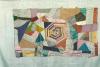
Patchwork quilt made from silk and challis and velvet hexagons set to form diamond shapes. The centre shape has 8 hexagons surrounded by a row of 16 hexagons. The outer border of the quilt is 2 rows of 'Tumbling Blocks' set amongst a variety of black silk and satin patches. There is a wide fringe in red, green, blue and yellow. There is no padding and the backing is a recent addition in red cotton, synthetis mix.
1770 x 1740mm
Gwen Cordinglay
Patchwork quilt made from hexagon patches in silks and rayons, in pinks, blues, red, yellow mainly, with pastels. No padding. Bordered and backed with green satin.
1829 x 1372mm
Margaret Williams
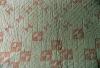
Frame quilt with central square of fabric around which the borders or frames have been added in strips. The fabrics are mostly floral, a heavy weight similar to damask or curtaining. The colours are mainly beige, brown, green and red. The original backing was a red paisly design. A second backing, of red, brown and yellow leaves on white (possibly dating from 1930s), has been added at a later date. Quilt is bound with brown fabric.
2200 x 2000mm
Diane Kern Hamilton
Dresden plate quilt with pointed pieces set around a white centre. Fabrics are checks, floral patterns and plains of the 1930s. The twenty blocks are sashed with plain mauve fabric which does not meet evenly in some places. The padding is two layers of cotton bedspreads. The backing is open weave rough quality cotton.
1860 x 1550mm.
Shelley Cameron
Cotton scrap quilt with shapes of squares and diamonds and strips. There is no padding and the backing is calico.
2125 x 1440mm
Elsie Shephard
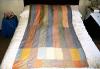
Double sided patchwork quilt/rug. Mainly squares machined together in strips (8 across). Average square 22 to 24cms. One side has a large piece of dark grey woollen material. The materials for the squares include tweed, mohair,many woollens, tartans and cream blanketing all of which were scraps or from used clothing.
1820 x 1680mm