Quilt No.63MC - Mare Carter

Mare Carter
Owner: 
Mare Carter
Location: 
NSW South East
Maker
Maker: 
Eva Leota Towe
Made in
USA
Date: 
1921 - 1940
Description: 
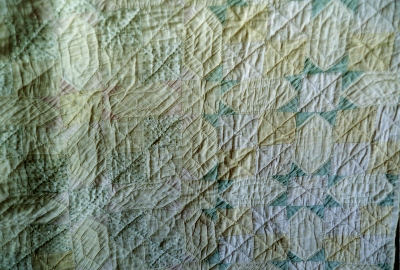
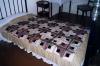
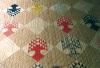
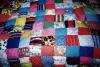
Patchwork Quilt, all cotton including filling. Pattern is "squares and diamonds". Quilt is faded but blue is probably the predominant colour. Hand stitched and hand quilted.
1624 x 1194mm
History: 

Made by Eva L.Towe in southern California in the 1930s. In 1950 her granddaughter Mare (Carter) came to Australia. In 1953 her grandmother died and in 1960 "my Mother brought me grandmother's legacy, her hand-works including the quilts, when she visited Australia". The quilt is now owned by Mare Carter who has 16 of her grandmother's quilts.They were used frequently as family quilts and now occasionally.

Story: 

"VINTAGE QUILTS 1898-1938
These quilts were made by my grandmother, Eva Leota Towe. Her maiden name was Tussey and she came from Missouri, U.S.A. In early 1900 grandmother moved to Washington State and later to Southern California.
Patchwork was our family tradition. It provided a frugal means to "dress" a home and to make cosy beds which were also pretty. I rarely saw grandmother without her bag of patches and templates handy, rarely saw her sitting idle; usually while chatting or listening to the radio, she'd be quietly piecing together patches which were cut mostly from used garments. Her scissors were kept sharp by my grandfather, she wore out countless thimbles, her needles were regularly pushed in and out of a little sock of sand to ginger up their points. The actual quilting was often done in company with friends who belonged to the Rebecca Lodge. At least one of these quilts is a Friendship Quilt made and signed by those women in 1933.
Grandmother also embroidered, to decorate her tables, her aprons and also her tea-towels which were always made from bleached flour sacks. It embarrassed my Mother and her sister that their underclothes were made from the same materials. Maybe this is why sewing and handcrafts skipped a generation in my family. The contribution my mother made was to keep these things safe and gradually pass them along to me.
My children suffered from allergies. Wool was too itchy, and too hot. The cotton quilts of my grandmother were perfect for our beds here in Australia. Thus we used our legacy to good purpose. Sadly, most of the quilts are now tattered and worn, but much loved for that, and for the affection which she sewed into them. She never made things to be preserved as objects of art. They represent her creativity, her duty as a woman and a home-maker, and her principle means of recreation and sociability."
[Mare Carter, Foxground, 1998]
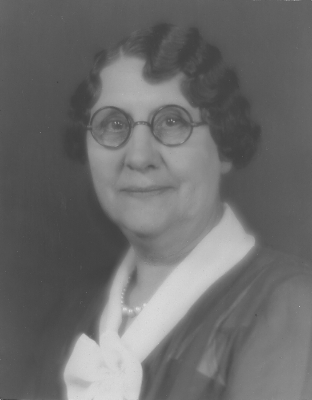
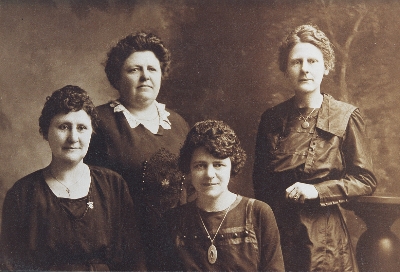
Eva Leota Towe c 1940

Related Quilts:

Wangaratta Historical Society
9 large blocks of crazy patchwork in silks and velvets. The blocks are divided by strips of deep ruby coloured silk. There is a wide ruby border with peaks to which is attached cream lace. The backing is beige silk. The main blocks are outlined with feather stitch in gold thread and many individual patches are outlined in fancy stitches and have embroidered motifs some of which are Australian eg centre patch has Sturt's Desert Pea flowers, parrots, wattle. There are also English flowers, Japanese motifs, flags, domestic objects and Marianne's initials. Embroidery is in a variety of threads including chenille.
2250 x 2180mm
Mrs Joan McGregor
Large and small pieces, mainly rectangles and mainly cottons, machine sewn. One side has replacement materials in red check, brown, tan, blue and pink materials. The padding is an old woollen blanket.
1950 x 1327mm
The Pioneer Women's Hut
Double sided utility quilt made from machine pieced squares of tailors' samples and men's and boy's suitings. The padding is 5 or 6 layers of pieced used clothing including darned, threadbare socks, part jumpers, blanket pieces etc.
2090 x 1340mm
National Gallery of Australia
" Reversible patchwork quilt of woollen suiting in grey, blue, navy, maroon and brown. The fabrics appear to be new tailor's sample pieces (the sizing is still present on the fabric, signifying it has never been washed). The patches are rectangular and vary in size. Both sides have different designs. The front of the quilt has 4 rows of 12 vertical rectangles then below this are 4 rows of 7 horizontal rectangles followed below by 4 rows of 11 vertical rectangles. The reverse of the quilt has a section at the top and bottom composed of 5 rows of 9 horizontal rectangles. The central area is made up of a centre section of 6 rows of 5 vertical rectangles; flanked on either side by a column of 10 horizontal rectangles and two columns of 8 smaller vertical rectangles.
The patchwork layers are joined at the edges with machine stitching. The patchwork layers and padding are machine quilted on the front down 2 vertical lines following joins in the patchwork; therefore not being totally straight. The lines are more noticeable on the reverse as the 2 sides do not match. The front face is displayed at the NGA.
Between the patchwork layers is a striped cotton blanket in black, sky blue, white and cream." [NGA]
2082 x 1386mm
Tasmanian Museum and Art Gallery
Cot quilt of mixed textiles and techniques. Made in sections and stitched together possibly with some padding. It features embroidered and appliqued animals (cats, donkey, elephant, squirrel, birds, kangaroo, emu) and nursery rhyme characters. Materials are cotton, silk, wool, imitation fur. There is a black velvet patch with a cross stitch parrot and embroidered date and initials 'May 1925 AE'. The backing is woven self patterned curtain material. There is a ruffle around the edge in the same material.
1400 x 930mm
Catherine Ringwood
The top of this quilt is 6 x 5 alternating squares and rectangles of check woollen material in 12 or more colour ways. Herringbone stitch in yellow stranded cotton is worked along each join and border.The border is plain grey wool. There is no padding and the backing is light blue crepe.
1118 x 814mm