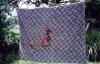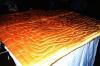
Quilt No.727CS - Catherine Llewelyn-Smith
Catherine Llewelyn-Smith
Owner: 
Catherine Llewelyn-Smith
Location: 
NSW Sydney
Maker
Maker: 
Unknown
Made in
TURKEY Izmir (formerly Smyrna)
Date: 
1901 - 1920
Description: 
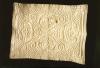
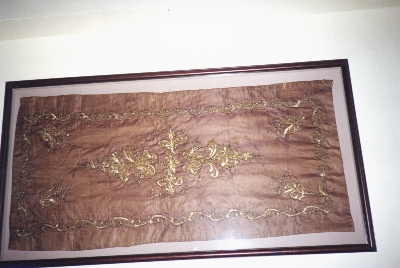
Quilt remnant. This piece of the top is hand embroidered in gold thread on a background of burgundy silk in a traditional style still practised by Greek women today. The backing is white and probably cotton or linen.
940 x 430mm
History: 

The maker is unknown but the remnant comes from a quilt made in Smyrna (now called Izmir) Turkey c.1900. The quilt was owned by Aikaterini (Antonopoulou) Pholeros of Smyrna. It then passed to her daughter Evelyn McLeod and is now owned by Evelyn's daughter Catherine Llewelyn-Smith.

Story: 

"A Remnant From Smyrna
This quilt remnant comes from the once-great city of Smyrna, now called Izmir, in Turkey, where Greeks had lived for hundreds of years, probably even back to 1000 BC and through the time of Alexander the Great. At the beginning of the C20th, Smyrna was a big, prosperous, Greek city.
The quilt belonged to Aikaterini Antonopoulo whose father was the head of Lloyd Triestino Shipping company in Smyrna. She married Frank Pholero born (1891) in Parkes NSW, son of Angleo Pholero of Smyrna who came to Australia in about 1870 and became Australia's first Greek Vice Consul.
Frank Pholero had become a senior official of the Anglo-Eastern Railway Company in Smyrna. His position there ended abruptly during the 'great catastrophe' of 1922 when, as a result of the terrible hostilities between Greece and Turkey, the city was torched and burned, thousands were killed, and over one million refugees poured into Greece.
Aikaterini and family fled, leaving behind their house and all possessions. Eventualy they arrived in Australia as penniless refugees, having spent almost two years on the island of Malta. At some time after fleeing Smyrna, Aikaterini received a parcel from Turkey. It seems that a maid she employed had managed to rescue a few items from their house in Smyrna and send them on; among them this piece (perhaps the centre-piece of the original bedspread) and the family photo.
Although not much else is known about the quilt, it can probably be assumed that, in true Greek tradition, the bedspread had been made especially for Aikaterini's prika (dowry), or that it may have been handed down to her through the family. The silk fabric and rich, gold embroidery certainly reflect the well-off position which the family would have enjoyed in Smyrna's 'pre catastrophe' days.
This remnant has been passed down through Aikaterini's daughter Evelyn McLeod, to her daughter Catherine, who with husband David Llewelyn-Smith have two daughters, Victoria and Rebecca.
[Written by Lula Saunders, adapted from interview 14/3/00 for the National Quilt Register]
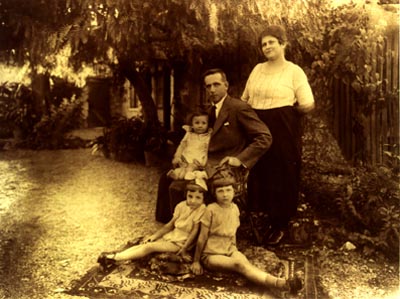
Aikaterini and Frank Pholero with Evelyn, Mildred and Cecil. Smyrna c.1920

Related Quilts:

Yvonne Hamdorf
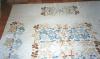
Wholecloth pram quilt with a top of pink cotton sateen, and the reverse is a more finely woven, ivory, fabric. All over quilting design as main feature, with stylised hearts, leaves and cross hatching. The padding is cotton batting. 870 x 660 mm.
John Tomkin
Hand stitched, cotton, appliquéd, quilt in a flower pattern on a plain background. Colours are shades of green, apricot and browns. This quilt was known as a 'Bride's Quilt'. Padding is thought to be layers of white fabric raised almost like a wadding. The backing is cotton material. 2470 x 2020 mm.
Rosemary Blake
Single bed quilt made from sugar bags stitched together covered with a ticking type fabric. This inner layer is then covered with muslin, dyed yellow. It is similar in construction to 80RB but much lighter as the sugar bags are lighter than the heavy jute potato bags.
1520 x 990 mm
Maria Patounas
The cotton quilt top is blue featuring a floral design in the centre and a matching border. The main quilting pattern relates to this. There is a wide gold cotton border with a quilting pattern of parallel lines and diamonds. The backing is plain red cotton. The padding is cotton wadding.
2040 x 1750mm
National Gallery of Australia
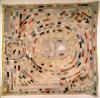
"This is a coverlet of pale blue cotton muslin, highly decorated with appliquéd pieced bands, figures, and embroidery. The edge of the quilt is finished with bands of yellow, white and green cotton attached with ladder stitch.
Down the centre field of the design and 4 poems embroidered in quite crude chain stitch. Each piece of prose is accompanied by an appliquéd illustration. For example a large clock accompanies a poem of time. 'While shepherds watch their flocks at night�.'is illustrated with a beautiful scene of the manger watched by an angel, cows and sheep. The appliqué and embroidery is executed crudely with large stitches in running and overcasting. The quilt is signed, 'M.J.H. aged 84 yrs.1924.' " [NGA] There is no padding or lining. 1640 x 1540mm
Kereake Wray
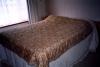
Wholecloth Greek quilt. "The fabric is a beautiful silk satin with a formal pattern of soft yellows and pinks on a turquoise background. Surrounding this is a 40cm wide border also of silk satin (cerise coloured). The quilt is machine pieced but hand quilted. The method of quilting is very interesting. A thick cream twist has been used and at first glance it seems that the quilt is tied as there are long pairs of stitches with gaps of about 4cm between them. However, either a long needle was used to make a pair of stitches OR each side may have been quilted separately with the needle only going half way into the wadding which is about 2 cms thick." [Kereake Wray] The padding is kapok approx 2 cm thick and the backing is deep coral pink satin. 2200 x 1960 mm.