
Quilt No.763PHM - Powerhouse Museum
Owner:
Powerhouse Museum
Location:
NSW Sydney
Maker
Maker:
Unknown
Made in
AUSTRALIA
Patterms
Date:
1851 - 1880
Description:
"A rectangular patchwork quilt made in the 'tumbling blocks' pattern using dark and lighter patterned silks. In 'tumbling blocks', one light, one medium and one dark toned diamond piece are joined to form a hexagonal shape. The hexagons are pieced with the different tones regularly oriented so that they create a three dimensional illusion of rows of cubes or blocks. The quilt is hand pieced throughout and bordered with a tobacco-coloured glazed chintz. The backing papers have been removed." [PHM]
There is no padding or backing.
3012 x 2002mm
There is no padding or backing.
3012 x 2002mm
History:
The quilt is thought to have been made c.1880 but the maker is unknown. Suzanne McGrath of Kirribilli, Sydney gave the quilt to the Australian Costume and Textile Society (ACTS). In 1983 the ACTS gave its collection to the Powerhouse Museum.
It is used for research and exhibition purposes only.
Related Quilts:
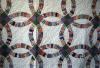
Repeat block in wedding ring pattern. All cottons with cream background and mainly pale mauve and green dressmaking prints in wedding rings. Green border and cream calico backing. The padding is cotton. 1800 x 210mm.
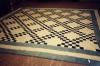
Cotton quilt made in the USA. The pattern is 'Double Irish Chain'. It is machine pieced and hand quilted. The backing is calico and the padding is cotton,
2134 x 2134mm
2134 x 2134mm
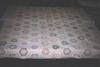
Handsewn quilt of hexagon patches in cotton prints in 'Grandmother's Flower Garden' pattern. Each flower consists of double rows of print hexagons around a yellow centre and these are joined by 'paths' in plain green and white cotton. Backing is green cotton and there is a wool padding. There is outline quilting around all green and white hexagons and centre and first row of hexagons in flowers.
1885 x 1750mm
1885 x 1750mm
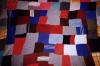
Double sided patchwork quilt. Machined squares and rectangles joined in strips and then the strips joined. Wide variety of materials, mainly woollen from hand or machine knitted jumpers, many patched. All materials came from worn garments from family and friends of the maker. No padding.
1860 x 1410mm
1860 x 1410mm
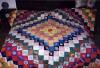
Patchwork quilt made in the 'Trip Around the World' pattern, from cottons and some fine dress linen, in bright and pastel solids. Each colour is placed in a diamond shape on the quilt. Patches are 10cm square, quilt has 620 squares. The linen was mainly used to work the cross stitch. Quilt has a 2 inch border in black. Backing is sheeting. Each square is embroidered, with many different stitches, in geometric, floral, animal, insect and abstract designs, in different colours.
2760 x 2350mm
2760 x 2350mm

Crazy patchwork quilt with mainly patterned pieces in a wide variety of designs and colours. Backing is wholecloth patterned cotton. The quilt is edged with a checked bias binding. Machine construction.
2299 x 1449mm
2299 x 1449mm