Quilt No.973NGA - National Gallery of Australia
National Gallery of Australia
Owner: 
National Gallery of Australia
Location: 
ACT
Maker
Maker: 
Mary Hannaford
Made in
AUSTRALIA NSW
Date: 
1921 - 1940
Description: 
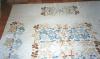
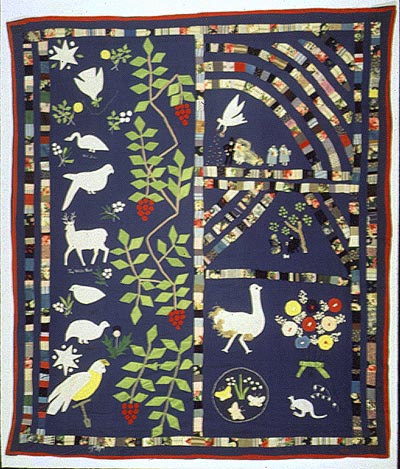
" This coverlet is composed of two pieces of dark blue cheese cloth joined with a row of running stitches down the centre of the coverlet (the seam faces the front face of the coverlet but is hidden beneath a row of appliqué).
The coverlet is decorated with rows of pieced work surrounding appliquéd and embroidered scenes. A panel down the LHS of the quilt and a smaller panel lower RHS depict animals and floral images. In the centre RHS an elderly couple sit beneath a tree. In the upper left a bride and groom accompanied by three flower girls are showered with petals from a wicker basket...
History: 

The quilt was made by Mary Jane Hannaford about 1922 at Blanford, near Murrurundi, New South Wales.
"There are seven known quilts initialled 'M.J.H.' five of which are owned by the National Gallery of Australia. Mary Jane's great granddaughter, Miss Joan Swanson, New South Wales donated this quilt to the National Gallery of Australia in 1997." [NGA]

Story: 

"Mary Jane Hannaford was born in Devonshire, England in 1840. She came to Australia on board the 'London', arriving in Sydney in March 1842. The family moved to Tamworth after the Australian Agricultural Company contracted her Father as shepherd. Her father died in 1852, when Mary was 12. Her Mother remarried 2 years later and they moved to Blanford near Murrurundi, New South Wales. Mary Jane lived with her parents until they died and continued to live with her brother on the farm 'Balmoral'. She never married, but had a daughter, Emily Agnes Hannaford who married George Cady in 1887. Mary Jane died in Blanford in 1930." [NGA]

Related Quilts:
Yvonne Hamdorf
Wholecloth pram quilt with a top of pink cotton sateen, and the reverse is a more finely woven, ivory, fabric. All over quilting design as main feature, with stylised hearts, leaves and cross hatching. The padding is cotton batting. 870 x 660 mm.
John Tomkin
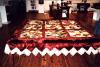
Hand stitched, cotton, appliquéd, quilt in a flower pattern on a plain background. Colours are shades of green, apricot and browns. This quilt was known as a 'Bride's Quilt'. Padding is thought to be layers of white fabric raised almost like a wadding. The backing is cotton material. 2470 x 2020 mm.
Powerhouse Museum
"A tied patchwork wagga quilt made from swatches of men's wool suiting fabrics in blue/grey and pink/brown tonings. Rectangular swatches have been cut in half diagonally, and the resulting right-angled triangles paired to form larger equilateral triangles which alternate dark with light across the field. The quilt has been machine and hand pieced, then machined in vertical stripes.
The centre field is bounded by two strip-pieced borders at top and bottom, and three down each side. These are sewn from rectangles, using light pink/brown tones for the inner border and darker colours for the outer borders. The quilt is padded and backed and the side seams are secured with black herringbone stitch. The three layers are tied together invisibly with lazy daisy stitches in black cotton from the back." [PHM] The padding is a wool blanket and the backing is two pieces of cream twill cotton.
2030 x 1440mm
 Cynthia Mayes
Wholecloth quilt of fine cream homespun embroidered with red and white stranded cotton. It is a cross stitch design of roses pre stamped on the material. The quilting consists of a fern pattern medallion in the centre, straight lines and a fern pattern border. The padding is fine wadding and the backing is white sheeting with a small floral pattern,
2160 x 1650mm
Maria Kirke
Wholecloth quilt made from deep pink satin. The quilting pattern is a centre circle with a stylised flower surrounded by crescent shapes. This is set in a square and there is a fan design in each corner. Parallel lines create a border. There is a frill on all sides of the quilt. The padding is raw cotton.
2000 x 1770 mm
Heather Leonard
This 'Quilt' is made from an army great coat from the second world war. The seams have been unpicked and pieced together by machine zig-zagging the flat edges (with Singer treadle sewing machine). The pocket slits are turned back and seamed rather than being pared off. The outside edges are turned over and blanket stitched in red. It does not have a backing.
1620 x 1180mm