
Quilt No.976NGA - National Gallery of Australia
Owner:
National Gallery of Australia
Location:
ACT
Maker
Maker:
Isabella Cooke
Made in
AUSTRALIA NSW
Patterms
Date:
1921 - 1940
Description:
"This unusual quilt is comprised of bands of horticultural show ribbons machined onto a blue lining. The ribbons are royal blue in colour and printed in gold/bronze with two inscriptions.
KYOGLE P.A & H SOCIETY and TWEED RIVER AGRICULTURAL SOCIETY
The quilt has been formed so the two inscriptions alternate down the face of the quilt. The ribbons appear to be of rayon. White cotton machine thread was used in the construction. Accompanying the quilt is a carry bag; a rectangular bag made of the same show ribbons as the quilt with a single drawstring at the top." [NGA] The quilt is not padded...
KYOGLE P.A & H SOCIETY and TWEED RIVER AGRICULTURAL SOCIETY
The quilt has been formed so the two inscriptions alternate down the face of the quilt. The ribbons appear to be of rayon. White cotton machine thread was used in the construction. Accompanying the quilt is a carry bag; a rectangular bag made of the same show ribbons as the quilt with a single drawstring at the top." [NGA] The quilt is not padded...
History:
"Mrs Isabella Cooke (Australia 1860-1942) made this quilt around 1930. It remained in the artist's family until the National Gallery of Australia purchased the quilt from a private collection, Australian Capital Territory, in 1992." [NGA]
Related Quilts:
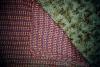
Traditional Wagga rug made from 3 wheat bags joined along the long side by sewing with bag needle and twine. Machined twill cover was put on later in the 1960s. Originally no padding but now the bags are the padding. One of a pair(identical).
1790 x 1160mm
1790 x 1160mm
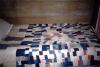
Double sided quilt. Side 1 has an off centre frame based on a hexagon and including triangles and squares in a concentric pattern. The borders are all small rectangles with a single strip of large rectangles at one end. Side 2 has a central patch of pieced shapes appliqued to the background. The borders are squares and rectangles many in striped shirting cotton. Side 1 has minimal quilting to the interlining but it does not go through to side 2. The padding is a thin sheet.
The circle (sometimes pieced hexagons) is common to other 'Craigmoor' quilts.
1450 x 1230mm
The circle (sometimes pieced hexagons) is common to other 'Craigmoor' quilts.
1450 x 1230mm
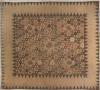
This quilt is of hand pieced hexagons randomly placed and stitched on to a linen backing. They are mainly dress fabrics and chintz with some hexagon flowers in the centre and corners in broderie perse. There is no padding.
2600 x 2600mm
2600 x 2600mm
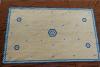
Patchwork quilt made of 1 inch hand paper pieced hexagonal patches (English technique), with plain and floral patterned blue fabrics in clusters at regular intervals throughout the taupe coloured patches. Centre of quilt has a cluster or 'flower' of 4 rings of patches, the centre group embroidered in blue satin stitch: 'MW 1938'. Border consists of 3 rows of medium, light and dark blue hexagons. No padding. Backing is of blue cotton sateen.
2185 x 1372mm
2185 x 1372mm
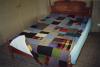
Patchwork quilt made from rectangles and squares of woollen fabrics from dress making projects. Colours are mainly grey, blue, brown, green, with some red and yellow. Fabrics are plain, cheks and stripes. No padding or quilting. Backing is made of white flannelette sheets. The quilt has been lengthened after it was completed, and the backing sheet has been added to at the same place.
2470 x 1320mm
2470 x 1320mm
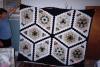
Hand pieced patchwork quilt with 10 diamonds consisting of hexagons with white and black rows as edging. Materials include furnishing and dress materials and a type of linen. It is not quilted or tied. The backing is a small floral print in flannelette.
2180 x 1830mm
2180 x 1830mm