Quilt No.1044JW - Julie White

Julie White
Owner: 
Julie White
Location: 
WA South West
Maker
Maker: 
Annaliese Goerling
Made in
AUSTRALIA WA
Date: 
1941 - 1970
Description: 
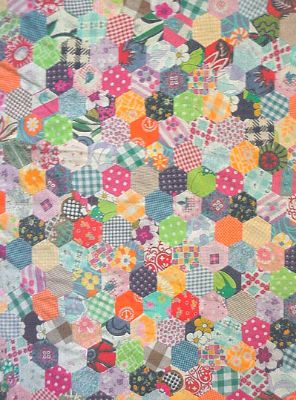
Hand stitched hexagon quilt in a wide variety of patterned cottons. Made completely from dressmaking scraps from clothes made for the maker's children and grand children. The hexagons are randomly placed. There is no padding and the backing is fawn cotton. 2260 x 1430mm.
History: 

The quilt was commenced in 1969 by Anneliese Goerling in Perth WA. It is now owned by Julie White. It is not used.

Story: 

"Maker was born in Kassel, Germany on 26.2.1903 into a well-to-do family. Her husband, German by descent but born in Victoria, met her in Germany. After their marriage they came to Australia where they owned Marloo Station in the Murchison district of WA. Heinrich's family were all interested in hobbies, particularly photography. Heinrich enjoyed cine photography and some of his film of station life in the outback is now in film archives. The couple had four daughters before moving to Pinjarra in 1933 where they farmed cattle and sheep until Heinrich's death in 1946. Anneliese, now with seven children, continued on the farm as best she could by share farming. After selling the 1000 acre farm to Alcoa in 1969, Anneliese began making the quilt in suburban Booragoon. Anneliese had always enjoyed dressmaking for her children and grand-children so making a quilt was a creative activity to help bridge the gap from farm to suburban house - and it was a good way to use some of the dress-making scraps she had always saved. She later bought a knitting machine which she used a lot. Anneliese also sewed many stamped tapestries which gave her the feeling that she was painting. She began that hobby at the age of about 70 and continued making about 80 tapestries until she was about 90 not long prior to her death on 25.3.2000. [Julie White]
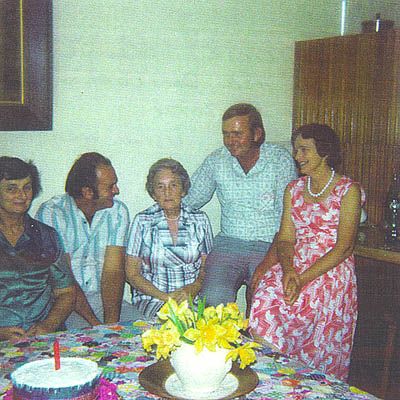
Anneleise with her children on her 70th birthday with the quilt as a tablecloth.

Related Quilts:

Lyn Cottingham
Single bed quilt hand pieced from silk hexagons using the English method. The border, backing and central rosette of hexagons are black. All other hexagons are a mixture of plain colours, stripes and florals. They are randomly placed. It is quilted in a diamond pattern. The padding is a thin cotton woven material.
1550 x 1330mm
Harden Murrumburrah Historical Society
Patchwork quilt has pieced blocks in the 'Ohio star' pattern in red print and white cotton, alternating with plain white blocks. Quilt has a 9cm frill in red and grey geometric print cotton, machine stitched around the edge. Quilt appears to have some hand quilting. No padding. Backing is white cotton.
2210 x 2060mm
Yass & District Historical Society
Patchwork quilt made from diamond patches in the 'Cotton Box' pattern, in a wide variety of cotton fabrics, including plains, checks, stripes and florals. The patches have blotting paper templates. The quilt is edged with diamond shapes in a red floral cotton. The backing is of the same red floral pattern, featuring yellow, turquoise and white flowers and leaves. Hand sewn.
2135 x 2033mm
Ankie King
Small square piece of crazy patchwork in silks and taffetas. Many of the seams are oversewn with decorative embroidery stitches. There is a calico backing.
550 x 550mm
Glenda Wilkinson
Small quilt made from pieces of heavy weight wooollen coat material cut into strips and machined together. It is reversible. Each side is made from different materials but in similar colours of aqua, blue, green and beige. The 2 layers are quilted together with a few machined lines of straight stitching. It has a folded and machine stitched edge. There is no padding.
950 x 790mm
Dubbo Museum & Historical Society Inc
"English patchwork pieces. 1110mm x 1500mm. Hand pieced by at least two people. Made from scraps, cut down clothing and sheeting. Backing made from shirtings, dress fabrics, furnishing fabric and ticking. No synthetics. Machine quilted. Condition, fragile�.." [Dubbo Museum]