Quilt No.723ES - Elsie Shephard

Elsie Shephard
Owner: 
Elsie Shephard
Location: 
NSW Riverina
Maker
Maker: 
Elsie shepherd
Made in
AUSTRALIA NSW
Date: 
1941 - 1970
Description: 
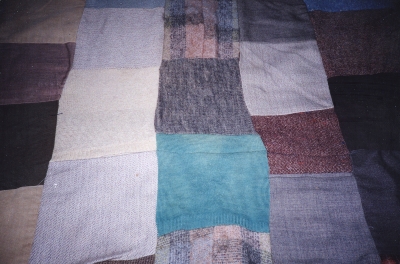
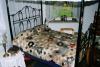
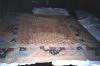
Double sided patchwork quilt/rug constructed from squares machined together in strips and then the strips joined. It is made in one piece and then doubled over. The materials are mainly wool, worsted, part cream machine made jumper, pink and blue mohair, blue and white spotted flannelette and cream blanket and all are scraps or from worn clothing.
1690 x 1370mm
History: 

This quilt was one of many made by Elsie Shephard at Rosewood NSW between 1957 and 1970. They were made for warmth on the children's beds. It is still owned by Elsie and still used.

Story: 

"Patchwork Rugs
When my husband was seriously hurt in a road accident in 1956 he was in hospital for a year then another two years recovering until he was fit enough to get a permanent job.
There were no Government handouts to needy families then so you had to do your best to balance the budget and make ends meet. Having a young family, people were very kind to me, giving me clothes for my children their children had grown out of that were in good order, some were slightly worn and needed patching.
When my husband had a permanent job people still gave me clothing because I had six children, even though I could afford to buy clothes for them. Because of their kindness I could never say 'no'. I would thank them saying 'nothing will be wasted, I'll make use of what you have given me'.
Being so cold at Rosewood I decided to make patch work rugs for all my children's beds out of garments I knew would never be worn, keeping my word 'I'll make use of what you have given me'.
There was no design or pattern in anything I made, I just kept cutting things up into squares, then stitching the squares together into rows, then sewing the rows together. Whatever colour was in the bobbin I sewed with. I never lined the rugs as I had always sewn enough squares together to just fold the sewn rows over and have the rug doubled. I made some rugs for my husband to take camping.
My eldest daughter slept in the coldest room in the house. One night I finished her rug, put a lining in it and put it on her bed when she was asleep. It was that heavy that during the night she woke up thinking an animal was on top of her bed! I took the lining out."
[Elsie Shephard 1.4.2000]

Related Quilts:
Kapunda Historical Society
Patchwork quilt made from cotton fabrics in stripes, small prints, and plains. Centre block is pieced red and white triangles within a blue and white striped frame, with a row above and below of triangles in a flying geese pattern. Two rows of triangles in the flying geese pattern are on either side the full length of the quilt. Quilt is bordered with red cotton. Colours are red, white, pink, blue and yellow. Padding is probably a woollen blanket, the backing is linen. Closely quilted all over.
2180 x 1930mm
National Gallery of Australia
"This quilt follows the traditional hexagon patchwork pieced pattern, which are then joined and sometimes edged with a contrasting border. The edges of the quilt have been turned and then scalloped edges made of identical patches to the main body of the quilt have been attached to the edge. The quilt is fully lined, and the lining is visible front the front face through the gaps between the scalloped edge. The lining is attached to the patchwork with a row of stitches along the edges; there are no stitches in the centre field. The fabrics of the quilt are plain weave cotton in simple floral and geometric designs. Most of the fabrics are monochromatic. Several different colour ways of the same fabric are evident which could suggest some fabrics were from manufacturer samples. The lining is a William Morris print.
Each of the patchwork pieces (there are several thousand present) are sewn together with very fine overcasting stitches. The quilt is entirely hand sewn. There is some evidence that templates from the hexagon pieces possibly blotting paper, remain in situ���The quilt is not padded or quilted. The lining is fine twill weave cotton printed in pink and pale purple. The design follows William Morris's 'Strawberry Thief design'." [NGA] 2075 x 1911mm
The Queensland Women's Historical Assoc.
Frame quilt in cotton with cotton backing. Centre square of floral chintz surrounded by 8 smaller squares with floral and probably Egyptian motifs. 4 surrounding frames of plain and patterned cotton in squares, diamonds and strips. Hand stitched and hand quilted. Has been used as a curtain and has metal rings attached to one edge.
3759 x 2286mm
Irma Whitford
Pieced repeat block in 'Dresden Plate' pattern in a variety of fabrics with pink and pale blue predominating. Scalloped outer edge. Machine pieced and hand quilted, with echo quilting of four petals between the 'Dresden Plates'. The padding is polyester, and the backing is white calico. 2600 x 1630 mm.
Queen Victoria Museum and Art Gallery
Unfinished patchwork top made from hexagon patches in the 'Grandmother's Flower Garden' pattern, in glazed and unglazed cottons and some twill fabrics. 7 patches for flowers with white and some cream patches forming paths. All fabrics are patterned and date from c.1825-1840, including pieces of toile de jouy, stripes and florals. Colours are predominantly reds and blues with some green, brown, purple; one flower is in chrome yellow, 8 flowers are in turkey red indicating probably the latest fabric. The quilt is hand sewn and the papers are in tact in most patches.
1508 x 940mm
Mare Carter
Patchwork quilt, all cotton including cotton filling. Pink and white. Large plain pink blocks with white pieced blocks in between in arrow type pattern based on rectangles. Hand sewn and hand quilted
1931 x 1728mm