Quilt No.758PHM - Powerhouse Museum

Powerhouse Museum
Owner: 
Powerhouse Museum
Location: 
NSW Sydney
Maker
Maker: 
Caroline Mary West
Made in
AUSTRALIA NSW
Date: 
1921 - 1940
Description: 
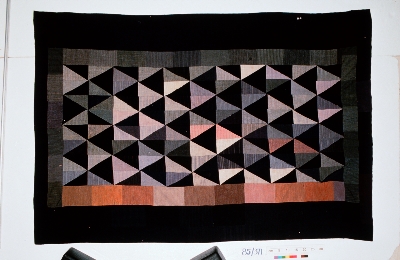
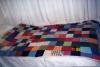
"A tied patchwork wagga quilt made from swatches of men's wool suiting fabrics in blue/grey and pink/brown tonings. Rectangular swatches have been cut in half diagonally, and the resulting right-angled triangles paired to form larger equilateral triangles which alternate dark with light across the field. The quilt has been machine and hand pieced, then machined in vertical stripes.
The centre field is bounded by two strip-pieced borders at top and bottom, and three down each side. These are sewn from rectangles, using light pink/brown tones for the inner border and darker colours for the...
History: 

The quilt was made by Caroline Mary West about 1930 on a property near Trundle NSW in about 1930. It was handed down through the women of the family, to her grandson Mr. Ian Foster of Newport. Ian Foster gave the quilt to the Powerhouse Museum in 1985.

Story: 

"The quilt was made by Mrs. Caroline Mary West (nee Bray) in about 1930. Caroline was born on the 14 June 1872 and married a grazier, Everett Pearson West, in 1904. They lived on a property near Trundle, in the centre-west of New South Wales and had six children, four boys and two girls between 1905 and 1915. The quilt is thought to have been made in the 1920s or early 1930s during the Depression. The woollen suiting fabrics used to make the quilt were obtained from Tom Ellis, the local tailor. Caroline Mary West died on 19 March 1947." [PHM]

Related Quilts:
Ann Hockey
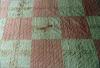
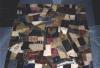
Patchwork quilt made from rectangles of samples of men's woollen suitings, in greys and blues and some browns. The rectangles were machine sewn together and then sewn in rows or strips. Originally the quilt had a rabbit skin backing, removed due to deterioration. No padding. Machine sewn.
1550 x 1420mm
The Pioneer Women's Hut
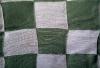
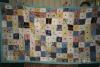
Double sided patchwork quilt. Machined squares and rectangles joined in strips and then the strips joined. Wide variety of materials, mainly woollen from hand or machine knitted jumpers, many patched. All materials came from worn garments from family and friends of the maker. No padding.
1860 x 1410mm
June Dean
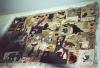
Pieced hexagons, English paper method. Large hexagons form the centre with a border of smaller hexagons. The fabrics are all cotton in a wide range of colours and patterns. There is no padding. The backing is cotton, large white floral design on dark blue. The hexagons are hand pieced and the edges machined.
2480 x 1420 mm
Muriel Thompson
Hexagon quilt in pattern known as 'Grandmother's flower garden'. Hexagons of prints and plains with yellow centre to each flower, and plain pink outlines. It is hand pieced and hand quilted. Padding is cotton, backing is cream cotton. 2200 x 2000 mm.
National Gallery of Australia
"This is a coverlet of pale blue cotton muslin, highly decorated with appliquéd pieced bands, figures, and embroidery. The edge of the quilt is finished with bands of yellow, white and green cotton attached with ladder stitch.
Down the centre field of the design and 4 poems embroidered in quite crude chain stitch. Each piece of prose is accompanied by an appliquéd illustration. For example a large clock accompanies a poem of time. 'While shepherds watch their flocks at night�.'is illustrated with a beautiful scene of the manger watched by an angel, cows and sheep. The appliqué and embroidery is executed crudely with large stitches in running and overcasting. The quilt is signed, 'M.J.H. aged 84 yrs.1924.' " [NGA] There is no padding or lining. 1640 x 1540mm
National Gallery of Australia
"This is not a true quilt, but a pieced coverlet with a lining. The entire front face of the quilt is of pieced hexagonal and part hexagonal printed cotton patches. Pieces are joined with hand sewn over casting stitches of many different coloured cotton threads. The joining of the patches forms a 'daisy' pattern in some areas and in others it is random. The edge of the front face of the quilt carries a 40mm strip of cotton Chinoiserie which is then folded to the reverse of the quilt and becomes part of the lining. The template for the hexagon patches remains in many of the patches: writing paper and news print." [NGA]
The work is not padded "The lining at the edge of the quilt (for approx.175mm) is a plain weave fabric of a Chinoiserie design. The centre field of the lining is a rectangular panel of a twill weave brushed cotton fabric with a striped floral design." [NGA] 2215 x 2070mm