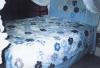
Quilt No.768PHM - Powerhouse Museum

Powerhouse Museum
Owner: 
Powerhouse Museum
Location: 
NSW Sydney
Maker
Maker: 
Unknown
Made in
ENGLAND
Date: 
1901 - 1920
Description: 
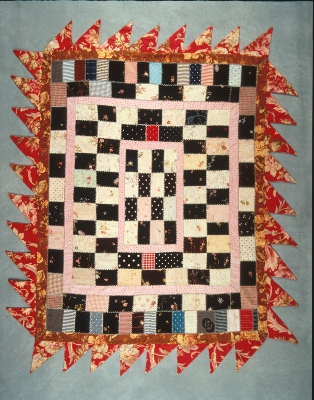
"A medallion style, handpieced cot quilt with dark and light checkerboard patterning of rectangular cotton printed fabrics, probably taken from a fabric sample book. Two frames of pink cotton strips printed with navy blue polka dots outline the central block and separate the outer rows of patches. The quilt is edged with narrow strips of brown floral cretonne and dramatic triangular 'flames' of red floral cretonne attached all around. The seams joining the patches are oversewn with blue featherstitch embroidery, and the quilt is backed with printed cotton." [PHM] There is no padding.
1480...
History: 

"The maker is unknown but is probably a woman from northern Lancashire. She was about 80 when she made the quilt and gave it to Annie Dixon, who lived in the same area, sometime before 1920. This was said to be her last quilt." [PHM] When Annie died her niece Margaret Juckes inherited the chest and its contents, which were sent to Australia in 1960. The Powerhouse Museum bought the quilt in 1989.

Story: 

"The quilt was once owned by Annie Elizabeth Dixon, who was born in 1880 and died in 1959/60. She spent her early years at Aynsome Farm (or Mill) near Cartnel in Northern Lancashire, then moved to nearby Kent's Bank. Annie migrated to Canada in 1920, leaving the quilt in England in a chest of things belonging to her. When Annie died her neice Margaret Juckes inherited the chest and its contents, which were sent to Australia in 1960��.." [PHM]

Related Quilts:
Mary Robertson
The suffolk puffs are mainly cotton in a wide variety of colours and plain and patterned materials. The puffs are small squares rather than the more usual circles. The backing is teal satin hand stitched to the top. There is a teal bow at one end. There is no padding.
1570 x 1100mm
Mare Carter
Patchwork quilt, all cotton including cotton padding. Pattern is based on squares and a cross. Variety of fabrics, plain and patterned. Hand stitched and quilted.
2083 x 1626mm
National Gallery of Australia
" A wide range of cotton fabrics have been used to make this quilt in the traditional log cabin style. The strips of the log cabin are joined by rows being hand sewn onto a small square backing fabric, each square of strips has then been hand sewn together to form the quilt. The work is backed with a sateen printed fabric decorated with paisley design. A strip of the lining trims the edge of the front face of the quilt. The lining is attached with machine stitching. There are numerous tacking stitches that remain in the front face of the quilt. There are approx 9000 pieces in the quilt, most being only 5mm in width.
The quilt is of three layers because the strips of the log cabin are attached to a backing piece, and then the quilt is lined; however it is not padded." [NGA]
The Queensland Women's Historical Assoc.
Frame quilt in cotton with cotton backing. Centre square of floral chintz surrounded by 8 smaller squares with floral and probably Egyptian motifs. 4 surrounding frames of plain and patterned cotton in squares, diamonds and strips. Hand stitched and hand quilted. Has been used as a curtain and has metal rings attached to one edge.
3759 x 2286mm
National Trust of Australia (VIC)
Double sided patchwork quilt. One side has a centre of pieced hexagons enclosed by borders of plain strips and pieced stars and squares. The other side has a printed Royal Coat of Arms (lion and unicorn) 'Honi Soit Qui Mal y Pense, Dieu Et Mon Droit', surrounded by wide borders of plain and printed materials in the style of frame quilts.
2400 x 2300mm
Fran Williams
Quilt with centre area of silk triangles framed with small squares and the rest of the top is larger squares. Wide variety of prints and plain materials. There is no padding. The backing is cotton and "E.M.B." is cross stitched in one corner. "Back is interesting as it's all the same fabric, joined but it appears to have been stitched with a running stitch (cf quilting) before it was attached to the front. It was definitely done after being joined as the stitching design follows through the seams." [Fran Williams]
2500 x 2500mm