
Quilt No.953WAQ - Western Australian Quilters' Association
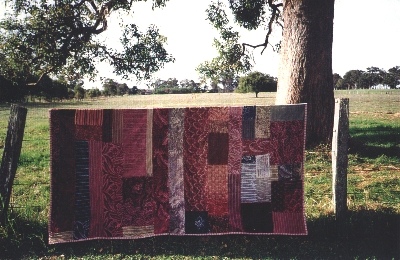
2000 x 1650mm
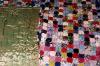
The quilt was made by volunteers of the Canadian Red Cross during WW 2 and finished in 1943. It was sent to England, with others, for people in need. It was one of two given to Alfred Vincent Petre and Winifred Marjorie Petre in Surrey when they lost the roof from their house. It was later inherited by their son Geoff who, with his wife Jan, brought it to Australia when they migrated to the Margaret River district of WA in 1982. In 2000 it was donated to the West Australian Quilters' Association by Geoff and Jan in memory of Geoff's parents.
"During WW2 1939-1945 Britain had endured the Battle of Britain, the London blitz, and by 1943 Germany was despatching pilotless flying bombs over England. There would be no warning of these attacks and they claimed many lives and wreaked much havoc with property. During one of these attacks the roof was blown off the Petre home in Sanderstead, Surrey. The next day the local authority (the Croydon Borough Council) and the Women's Voluntary Service came around to see what they could do to help. They gave the family two quilts which had been made by the Canadian Red Cross for relief of those in need. Unfortunately one quilt is now lost. The quilt would not have been particularly warm but its beauty must have given pleasure and solace to the Petre family. It also accompanied the two Petre children when they were evacuated the following year. The quilts were used regularly during the former owner's childhood. However, the most interesting uses came when Geoff Petre and wife Jan migrated to WA and settled in the Margaret River region in 1982. On the journey to Australia, the quilt was used as padding around the family's favourite and most precious picture - a beautiful 1856 engraving. The Petres ran one of the first B& B's in the region for five years and used the quilt there.
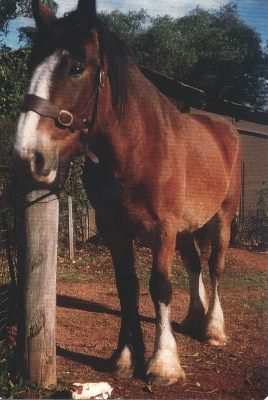
More creative uses were found for the quilt including as a blanket for their dogs and to transport one of their collie dogs and her litter of 8 puppies to the vet for vaccinations. It is believed to have been used to cover furniture whilst painting (a few paint spots on the back). It was also wrapped around a Clydesdale horse 'Rosie' for a few nights when Rosie was sick. Binder twine was tied around the corners to keep it in place, Rosie recovered.
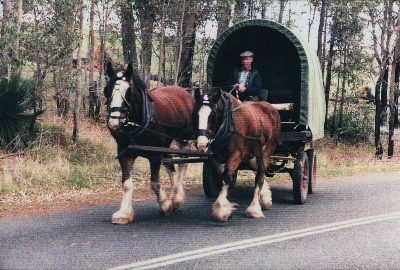
For five or six years the quilt was used as padding under various items when the Petres travelled by covered wagon pulled by the Clydesdale Rosie for the annual 'Ploughing Matches' field day weekends and then would be put over the bed at night."
[Joy Hill, Western Australian Quilters' Association for NQR 19/2/2001]
Related Quilts:
The patches are joined with hand sewing and embroidery, however the 12 panels are joined with machine stitching (chainstitch machine stitching). The blue silk lining was hand sewn into position with silk thread." [NGA]
"The quilt does consist of three layers but the central layer is not padding. The crazy patch pieces were sewn together and this was lined with white cotton fabric prior to the embroidery at the edges of the 12 panels being placed. This in turn was lined with a fine blue silk." [NGA] 1810 x 1460 mm
1525 x 1220mm
2415 x 2110mm
1626 x 1601mm
1740 x 1210mm.
2413 x 1626mm