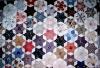
Quilt No.1044JW - Julie White

Julie White
Owner: 
Julie White
Location: 
WA South West
Maker
Maker: 
Annaliese Goerling
Made in
AUSTRALIA WA
Date: 
1941 - 1970
Description: 
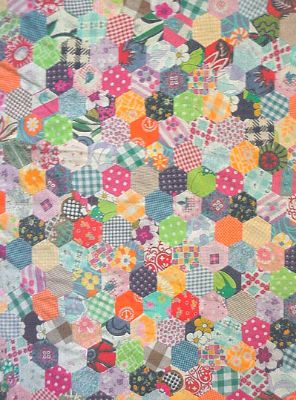
Hand stitched hexagon quilt in a wide variety of patterned cottons. Made completely from dressmaking scraps from clothes made for the maker's children and grand children. The hexagons are randomly placed. There is no padding and the backing is fawn cotton. 2260 x 1430mm.
History: 

The quilt was commenced in 1969 by Anneliese Goerling in Perth WA. It is now owned by Julie White. It is not used.

Story: 

"Maker was born in Kassel, Germany on 26.2.1903 into a well-to-do family. Her husband, German by descent but born in Victoria, met her in Germany. After their marriage they came to Australia where they owned Marloo Station in the Murchison district of WA. Heinrich's family were all interested in hobbies, particularly photography. Heinrich enjoyed cine photography and some of his film of station life in the outback is now in film archives. The couple had four daughters before moving to Pinjarra in 1933 where they farmed cattle and sheep until Heinrich's death in 1946. Anneliese, now with seven children, continued on the farm as best she could by share farming. After selling the 1000 acre farm to Alcoa in 1969, Anneliese began making the quilt in suburban Booragoon. Anneliese had always enjoyed dressmaking for her children and grand-children so making a quilt was a creative activity to help bridge the gap from farm to suburban house - and it was a good way to use some of the dress-making scraps she had always saved. She later bought a knitting machine which she used a lot. Anneliese also sewed many stamped tapestries which gave her the feeling that she was painting. She began that hobby at the age of about 70 and continued making about 80 tapestries until she was about 90 not long prior to her death on 25.3.2000. [Julie White]
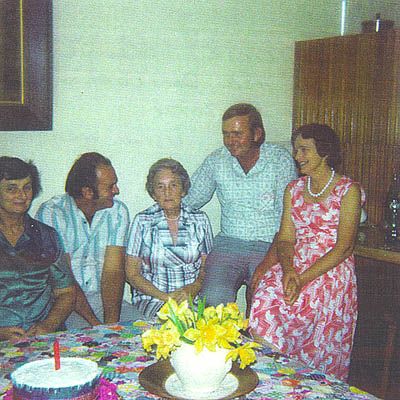
Anneleise with her children on her 70th birthday with the quilt as a tablecloth.

Related Quilts:

Name withheld
Quilt top in postage stamp pattern typical of military quilts. 5 x 5 blocks each 280 x 280mm. Colours are predominantly red, black and cream. Thought to have been made using uniform material from the Crimean war
1350 x 1350mm
National Parks & Wildlife Service of SA
Patchwork quilt of hexagon patches (3.5cm sides approx), handsewn, in cotton fabrics in sprig prints, stripes, checks, florals and plains. Colours are pre-aniline dyes, in lavender, green, red, beige and purple. Centre of quilt is pastel colours with a central patch embroidered in red: 'Elsey Rowbotham her work May 1 1869'. Quilt has a wide border of squares and triangles.Padding is thin cotton. Backing is off white calico. Quilted in parallel lines.
2693 x 2490mm
National Trust of Australia (SA)
Hand stitched unfinished crazy quilt with patches placed around a centre hexagon pieced in log cabin type strips. Materials are mainly silks and satins and pieces are mounted on grey cotton material. Seams are overstitched in herringbone stitch. 1520 x 760mm
Jindera Pioneer Museum
Quilt made of 26 x 13 rectangles of woollen men's suiting samples. Each rectangle is about 70 x 130 mm. Wide variety of patterns, mainly stripes, and colous. The padding is part of a worn cream blanket and joined pieces of woollen clothing. The backing is a well worn piece of brushed cotton. Machine made.
11900 x 1870 mm
Helen Cornish
Patchwork quilt in the Log Cabin pattern, each square 14cm x 14cm, made of used cotton fabrics with a fine wool fabric as the centre square of each. Colours are mainly reds, blues, greens and maroon, and pastels, in prints and plains. Quilt has a wide border of dark blue cotton with mitred corners. The padding is black and white mattress ticking, and the backing is the same dark blue cotton as the border. Machine stitched.
1770 x 1170mm
Friends of the Hawkesbury Art Society
Patchwork Quilt consisting of diamond shapes forming a Tumbling Block pattern. All cotton, mainly patterned pieces, with signs of blotting paper templates. Hand sewn. The outer border of patches consists of off-cuts from nurses' uniforms of the times as 2 of the maker's daughters were nurses. It is thought most other squares were probably from material samples from large city stores such as Anthony Horderns. Backing is red cotton in a paisley design.
2030 x 1890mm