Quilt No.466MDH - Mildura and District Historical Society
Mildura and District Historical Society
Owner: 
Mildura and District Historical Society
Location: 
VIC Northern
Maker
Maker: 
Mildura CWA Members
Made in
AUSTRALIA VIC
Date: 
1921 - 1940
Description: 
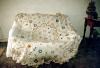
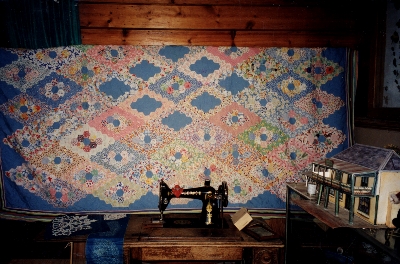
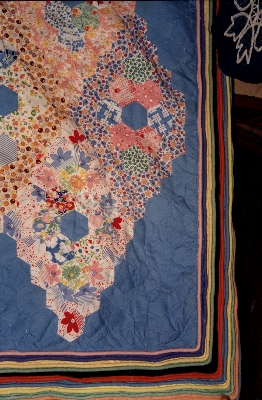
Quilt of 2025 hexagons stitched together to form diamond patterns. Hand sewn using paper templates. Materials are cottons and plains typical of the thirties period. The backing is blue cotton and the quilt is bound with many rows of coloured bias binding through which is treaded window cord. There is no padding. The quilt is called 'Grandmothers' Flower Garden quilt'.
2439 x 1829mm
History: 

The quilt was made in the 1930s by the President and members of the Mildura C.W.A. In the 1970s it was donated to the Mildura and District Historical Society. It is now on permanent display at Langtree Hall, a folk museum of local history that is behind the Cottage in Walnut Avenue Mildura.

Story: 

This quilt was commenced in the 1930s by the members of the newly formed Mildura branch of the Country Women's Association. Mrs. Edie Lawn was the president. She did most of the assembling and was also a memebr of Mildura Branch of the Embroiderers' Guild. The quilt was completed in 1938 after which it was displayed on special occasions and was always used as a cover on the President's table at the monthly meetings.
Forty years later Alice Farmer, Secretary of the Mildura and District Historical Society, accepted the quilt on behalf of the Society. It was originally in the Historical Society's rooms in the old power house. It is now on permanent loan to Langtree Hall where it is displayed.

Related Quilts:
The Pioneer Women's Hut
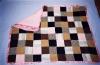
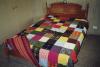
Patchwork quilt made up of 100mm multi coloured squares in a variety of materials including cottons, synthetics, lurex, plain and printed. Each square has dacron padding and is then joined in strips and the strips joined. All hand sewn. The backing is blue synthetic whole cloth 60mm of which is returned to the front to form a border.
1500 x 1200mm
Glenda Wilkinson
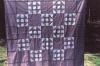
Quilt consisting of 30 blocks 360 x 360mm each (5 x 6). Each block consists of squares and rectangles arranged diagonally and edged with triangles. Each block is made from 2 or 3 different cotton materials, different colours but mainly pastels. It has not been quilted but tied with pink wool with 5 ties per block. Machine sewn with a folded and machine stitched edge. Padding appears to be coarse open weave cotton. The backing is printed flannelette.
2210 x 1850mm
National Gallery of Australia
"The Rajah "quilt" is a patchwork and appliquéd bed cover or coverlet. It is in pieced medallion or framed style: a popular design style for quilts in the British Isles in the mid 1800's. There is a central field of white cotton decorated with appliquéd (in broderie perse) chintz birds and floral motifs. This central field is framed by 12 bands or strips of patchwork printed cotton. The quilt is finished at the outer edge by white cotton decorated with appliquéd daisies on three sides and inscription in cross stitch surrounded by floral chintz attached with broderie perse on the fourth side. All fabrics used in the Rajah quilt are cotton with the exception of small amounts of linen and silk threads. The quilt shows evidence of being produced by many hands." [NGA] The quilt is not padded or lined. 3372 x 3250mm
Muriel Hartmann
Reused parts of hand knitted woollen jumpers patched together. Wide crocheted edge from wool unravelled from jumpers retrieved from the tip.
1905 x 1525mm
Fran Williams
Frame quilt with the centre frame featuring stars. These are English pieced and then appliqued on to the background using straight stitch on the machine. Borders are squares, rectangles and truangles. Mainly cottons. There is no padding. The backing is an old white bedspread similar to a Marcella.
1900 x 1930mm
N.S.W. Parks and Wildlife Service
Double sided quilt. Side 1 has an off centre frame based on a hexagon and including triangles and squares in a concentric pattern. The borders are all small rectangles with a single strip of large rectangles at one end. Side 2 has a central patch of pieced shapes appliqued to the background. The borders are squares and rectangles many in striped shirting cotton. Side 1 has minimal quilting to the interlining but it does not go through to side 2. The padding is a thin sheet.
The circle (sometimes pieced hexagons) is common to other 'Craigmoor' quilts.

1450 x 1230mm