Quilt No.385MC - Marie Colbron Conroy

Marie Colbron Conroy
Owner: 
Marie Colbron Conroy
Location: 
NSW Sydney
Maker
Maker: 
Phyllis ggow
Made in
PAPUA NEW GUINEA
Date: 
1941 - 1970
Description: 
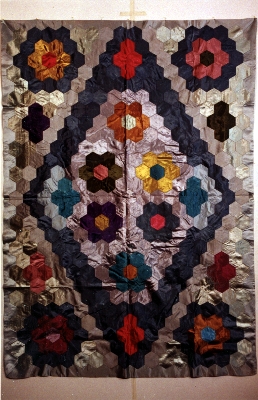
Quilt of 70mm hexagons forming rosettes. Satin material in plain colours. Background is several shades of grey. There is a 135mm silver grey border that is mitred and returns to the back. There is no padding. The backing is a darker grey. The quilt is signed by the maker and dated.
1870 x 1350mm
History: 

The quilt was made by Phyllis Gow in Port Moresby, Papua New Guinea, in 1964 for her Mother, Imelda Johnson. On her Mother's death the quilt passed to Phyllis and on her death to her husband. On his death the present owner bought the quilt.

Story: 

The maker went from Sydney to Port Moresby following her marriage in 1938 to Eric Mitchell on the 'Bulolo'. She was repatriated to Sydney during the war. Her husband died as a POW. Phyllis remarried in Sydney about 1954 and returned to PNG with her husband Allan Gow. They retired to Sydney in the early 1970s. The quilt was made for her Mother who lived with her during her latter years. The present owner, Marie Colbron Conroy, attended the same church as Phyllis and Allan Gow and on Allan's death purchased the quilt.

Related Quilts:
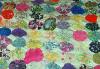
Helen Sparkman
Hexagon quilt made from dressmaking scraps from one neice. The quilt top only is complete and a few papers are still attached.
2250 x 2000mm
Art Gallery of South Australia
Frame cot quilt in cotton fabrics, the centre square in a paisley print surrounded by two plain borders or frames, then two frames pieced in alternate light and dark triangles, then a frame in a floral print. Outer border is of red fabric, longer at top and bottom to make a rectangle. No quilting. Machine sewn.
1050 x 770mm
National Gallery of Australia
"The quilt consists of 12 blocks of crazy patchwork with an embroidered border. The quilt is made of 167 different fabrics; most of these are silk. These velvets, printed silks and satins are beautifully embroidered with flowers, household items and Kate Greenway images of children at play. Many of the motifs have a strong influence from the Aesthetic Movement. The edge of the quilt carries a border in maroon silk decorated with tendrils and daisies in very fine embroidery.
The patches are joined with hand sewing and embroidery, however the 12 panels are joined with machine stitching (chainstitch machine stitching). The blue silk lining was hand sewn into position with silk thread." [NGA]
"The quilt does consist of three layers but the central layer is not padding. The crazy patch pieces were sewn together and this was lined with white cotton fabric prior to the embroidery at the edges of the 12 panels being placed. This in turn was lined with a fine blue silk." [NGA] 1810 x 1460 mm
Glenda Wilkinson
The quilt consists of 2 layers of random pieces of woollen coating and suiting materials machined together, very dark colours on one side and a mixture of dark and lighter on the other. The 2 layers are quilted together with a row of machining and has a folded and machine stitched edge. There is no padding.
1270 x 950mm
Annette Gero
Hand pieced hexagon quilt or table cover with centre motif of hexagons within hexagons. The remainder of the quilt is mainly hexagon rosettes. The materials are silks and brocades and it is pieced over papers in the English tradition.
1710 x 1600mm
National Gallery of Australia
" Reversible patchwork quilt of woollen suiting/upholstery fabrics in khaki, greys, blues and browns. Both sides have different designs. The front of the quilt has 13 rows of 12 vertical rectangles flanked on either side by a column of 22 horizontal rectangles. The reverse has a more interesting and complex design of small and very large rectangles, squares and triangles; with khaki contrasting with the duller greys and blues. The patchwork layers are joined at the edges with machine stitching and the quilt is machine quilted along 3 horizontal lines following joins in the patchwork; therefore not being totally straight. These lines are more noticeable on the reverse. The reverse face has been on display at the NGA." [NGA] There is a cotton blanket used as padding. 2054 x 1451mm