Quilt No.248HS - Helen Sparkman

Helen Sparkman
Owner: 
Helen Sparkman
Location: 
SA Adelaide
Maker
Maker: 
Matilda Pitt
Made in
AUSTRALIA SA
Date: 
1921 - 1940
Description: 
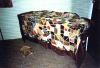
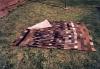
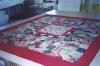
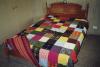
Patchwork quilt made from large pieces of cretonne and similar type cotton materials. On one side the seams and edges have been embellished with chain stitch.
2150 x 1220mm
History: 

This functional quilt was made by Matilda Pitt (born Bowman) (1860-1953) who was the great grandmother of the present owner. It is thought to have been made about 1920 and has always been owned by members of the Pitt family. It is not used now.

Story: 

"Matilda made these 3 quilts, probably in the early 1920s. Henry and Matilda Pitt and family lived at Stansbury S.A. until 1920 when they moved to a property at Balhannah S.A. The very cold winter in the Adelaide Hills created a need for extra night warmth, and so Matilda made 'rugs' for the family members, which by this time included grand children�����.As the description suggests , these quilts were quite heavy. The kitchen table provided an ideal work surface for these projects. These quilts represented very practical recycling, in an era when there was very little waste - even in the situation where there was no real need for thrift in this family. Matilda made quite a few quilts - the family members are fortunate to still have three of them."
[Helen Sparkman Dec. 2000]
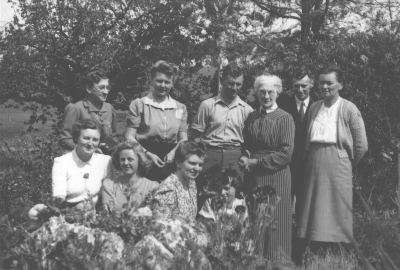
Matilda Pitt (3rd from right) and family members 1946

Related Quilts:

National Trust of Australia (NSW)
Quilt of small silk and rayon rosettes of hexagons in prints and plain materials including velvet, voided velvet, chine, printed silk, brocades, taffeta, satin, crepes. Many of the materials are from Japanese kimono and wrapping silks. It is pieced over papers, one paper has a typed date '1930'. The backing is black silk satin and is turned to the front to form a border.
1695 x 1390mm
Fiona Gavens
Hexagon quilt constructed over papers; all seams oversewn with featherstitch embroidery. Materials are vyella and clydella scraps from childhood dresses of the maker's first four children, augmented with scraps from a dressmaker and a book of samples. There is no padding; backing is plain, pale blue, brushed cotton.
2200 x 1720 mm.
Powerhouse Museum
"A tied patchwork wagga quilt made from swatches of men's wool suiting fabrics in blue/grey and pink/brown tonings. Rectangular swatches have been cut in half diagonally, and the resulting right-angled triangles paired to form larger equilateral triangles which alternate dark with light across the field. The quilt has been machine and hand pieced, then machined in vertical stripes.
The centre field is bounded by two strip-pieced borders at top and bottom, and three down each side. These are sewn from rectangles, using light pink/brown tones for the inner border and darker colours for the outer borders. The quilt is padded and backed and the side seams are secured with black herringbone stitch. The three layers are tied together invisibly with lazy daisy stitches in black cotton from the back." [PHM] The padding is a wool blanket and the backing is two pieces of cream twill cotton.
2030 x 1440mm
Hazel Jarmyn
Patchwork quilt made from cotton hexagon patches in the 'grandmother's Flower Garden' pattern, in bright prints and plains, with cream 'paths' made from dress material. Padding is flannel sheeting, and backing is the same cream material as the 'paths'. The centre of the 'flower' patches are autographed with friends' names and dates, as are some 'petals' and cream patches, in black ink.
1550 x 1400mm
Cressida Mary Webb Challis
Quilt of machine pieced squares and rectangles using a wide variety of materials in plain colours and patterns. It is one of a pair. There is no padding and the backing is 90cm strips of calico.
2500 x 2130mm
Gillian Sullivan
Quilt made of 9120 very small Suffolk Puffs, each one about the size of a 20 cent piece. "Each piece backed and the front of it drawn up like a reticule. It was not backed and was rather fragile, so I backed it on to a sheet, as it was heavy and in danger of tearing when lifted." [Gillian Sullivan]
2360 x 2230 mm