Quilt No.204MW - Margaret Wright

Margaret Wright
Owner: 
Margaret Wright
Location: 
VIC South West
Maker
Maker: 
Minnie Margaret Susan Thomas
Made in
AUSTRALIA VIC
Date: 
1881 - 1900
Description: 
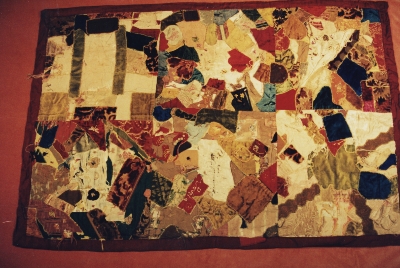
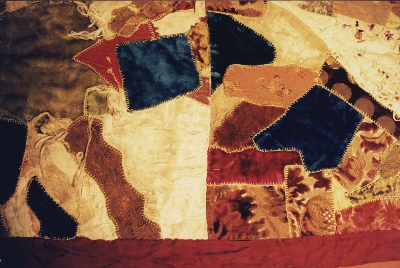
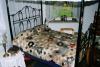
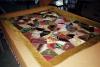
Crazy patchqork quilt, handsewn, composed of six large squares of patches in brocade, velvet and silk in random shapes and sizes. Patches are stitched to others by blanket stitch in yellow thread. Some patches have surface embroidery, e.g. a dragonfly, flowers, music notes, and names, 'Minnie', 'Loyetta' (house in Ballarat), 'Diana'. There are also five small cream bobbles. Colours are red, gold, brown, pinks, greens and blues. Padding is flannel, and quilt is backed and edged with maroon or burgundy ribbed silk.
1461mm x 687mm
History: 

Made by Minnie Margaret Susan Glover (later Thomas), in Ballarat (VIC). Started prior to her marriage in 1898. Owned by Minnie Thomas, then by her daughter-in-law Evelyn Thomas, then by Margaret Wright (born Thomas), grand-daughter.

Story: 

"Minnie Margaret Susan Glover was born at Sulky Gully, near Ballarat on 25/8/1868, the eldest of seven children of William and Jane Glover. The children were educated at home by a governess. In 1885 the family moved to 'Loyetta', 606 Drummond St South, Ballarat (house still standing). Minnie married William Emlyn Thomas in 1898 & lived above the Ballarat Banking [Company], Lydiard St North, Ballarat for much of her married life (Bank no longer standing). The quilt was exhibited in Stawell, Vic. in 1933 or 34, my parents were living there at the time."

"The quilt was used extensively during my childhood, mid 1930s - 1940s, particularly during childhood illnesses."
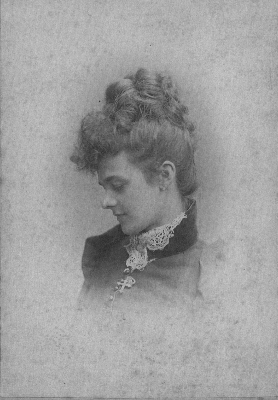
Minnie Glover July 28 1892, 23 yrs

Related Quilts:

National Trust of Australia (WA)
Hexagon quilt in dress and shirting cottons constructed in frame style with a centre rosette of 7 patches surrounded by 4 borders of patterned hexagons alternating with cream patches. The quilt has an inner border of triangles then rows of rosettes alternating with cream patches. The outer border is triangles. There is no padding. The backing is cream linen and has had a 20th century white cotton sateen slipstitched to it.
2045 x 1940mm
Helen Sparkman
Hexagon quilt made from dressmaking scraps from one neice. The quilt top only is complete and a few papers are still attached.
2250 x 2000mm
Kerrie Maloney
Double sided quilt made from woollen suiting pieces some of which have hand worked eyelets. Many of the rectangles are irregular. Both sides use similar pieces but arranged in different patterns. There is no padding.
2160 x 1524mm
Gillian Sullivan
Quilt made of 9120 very small Suffolk Puffs, each one about the size of a 20 cent piece. "Each piece backed and the front of it drawn up like a reticule. It was not backed and was rather fragile, so I backed it on to a sheet, as it was heavy and in danger of tearing when lifted." [Gillian Sullivan]
2360 x 2230 mm
Powerhouse Museum
"A tied patchwork wagga quilt made from swatches of men's wool suiting fabrics in blue/grey and pink/brown tonings. Rectangular swatches have been cut in half diagonally, and the resulting right-angled triangles paired to form larger equilateral triangles which alternate dark with light across the field. The quilt has been machine and hand pieced, then machined in vertical stripes.
The centre field is bounded by two strip-pieced borders at top and bottom, and three down each side. These are sewn from rectangles, using light pink/brown tones for the inner border and darker colours for the outer borders. The quilt is padded and backed and the side seams are secured with black herringbone stitch. The three layers are tied together invisibly with lazy daisy stitches in black cotton from the back." [PHM] The padding is a wool blanket and the backing is two pieces of cream twill cotton.
2030 x 1440mm
National Gallery of Australia
" A wide range of cotton fabrics have been used to make this quilt in the traditional log cabin style. The strips of the log cabin are joined by rows being hand sewn onto a small square backing fabric, each square of strips has then been hand sewn together to form the quilt. The work is backed with a sateen printed fabric decorated with paisley design. A strip of the lining trims the edge of the front face of the quilt. The lining is attached with machine stitching. There are numerous tacking stitches that remain in the front face of the quilt. There are approx 9000 pieces in the quilt, most being only 5mm in width.
The quilt is of three layers because the strips of the log cabin are attached to a backing piece, and then the quilt is lined; however it is not padded." [NGA]