
Quilt No.741HHT - HHT and the Hamilton Rouse Hill Trust
Owner:
HHT and the Hamilton Rouse Hill Trust
Location:
NSW Sydney
Maker
Maker:
Unknown
Made in
Unknown
Patterms
Date:
1881 - 1900
Description:
"This patchwork is pieced from twelve contained panels of Crazy Patchwork. Each panel is formed of rich silks of various weaves and textures couched on to a calico ground, each patch overlaid to create interesting 'artistic' shapes and contrasts. The rug is backed with gold polished cotton and bordered in blue and green cotton to three edges, maroon to the fourth. Embroidery in several colours, but predominantly gold, is used to advantage in the variety of stitches which define the edges of the pieces, and occasionally on the patches themselves."
[Historic Houses Trust ' Sydney Quilt...
[Historic Houses Trust ' Sydney Quilt...
History:
This quilt is part of the Hamilton Rouse Hill Trust. The maker is unknown. "The Crazy patchwork is associated with the interiors created by Bessie Rouse, nee Eliza Ann Buchanan (1843-1924), for her home, Rouse Hill, NSW. A c.1894 photograph of her studio shows it covering a folding iron chair. The fabrics cannot be identified with furnishing fabrics used in the house in the mid 1880s. It may have been a gift or purchase."
[Historic Houses Trust 'Sydney Quilt Stories' catalogue]
Related Quilts:
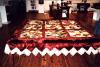
9 large blocks of crazy patchwork in silks and velvets. The blocks are divided by strips of deep ruby coloured silk. There is a wide ruby border with peaks to which is attached cream lace. The backing is beige silk. The main blocks are outlined with feather stitch in gold thread and many individual patches are outlined in fancy stitches and have embroidered motifs some of which are Australian eg centre patch has Sturt's Desert Pea flowers, parrots, wattle. There are also English flowers, Japanese motifs, flags, domestic objects and Marianne's initials. Embroidery is in a variety of threads including chenille.
2250 x 2180mm
2250 x 2180mm
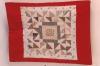
Frame cot quilt in cotton fabrics, the centre square in a paisley print surrounded by two plain borders or frames, then two frames pieced in alternate light and dark triangles, then a frame in a floral print. Outer border is of red fabric, longer at top and bottom to make a rectangle. No quilting. Machine sewn.
1050 x 770mm
1050 x 770mm
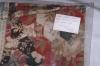
Cotton patchwork cover constructed from hand sewn hexagons (65mm) in cotton and linen furnishing materials. The curved edges are bound with blue and cream printed striped cotton. The backing material is not visible.
941 x 261mm
941 x 261mm
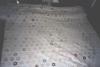
Patchwork quilt in Grandmother's Flower Garden pattern, consisting of 7 patch rosettes with white 'paths'. Cotton dress and shirting materials have been used in blues, pinks, brown, turkey red and Prussian blue. The quilt is hand sewn and each hexagon is 25mm wide. The backing is cream twill cotton in three panels. There is a hand sewn binding in red/pink cotton. There is overall quilting in chevron or zigzag pattern.
2415 x 2110mm
2415 x 2110mm
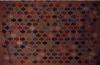
All over pattern of rows of hexagons with each unit made up of 4 hexagons each 45mm. Patterned and plain materials thought to date from the 1930s including cotton and linen dress materials, synthetics and synthetic crepe. It was an unfinished top and Meg Orr, the present owner, finished it by machine stitching some of the hexagon rosettes to the red twill background and stitching on a backing. There is no padding.
1740 x 1210mm.
1740 x 1210mm.
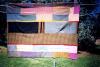
The quilt consists of 2 layers of random pieces of woollen coating and suiting materials machined together, very dark colours on one side and a mixture of dark and lighter on the other. The 2 layers are quilted together with a row of machining and has a folded and machine stitched edge. There is no padding.
1270 x 950mm
1270 x 950mm