Quilt No.936HS - Helen Sparkman

Helen Sparkman
Owner: 
Helen Sparkman
Location: 
SA Adelaide
Maker
Maker: 
Clara Pitt
Made in
AUSTRALIA SA
Date: 
1941 - 1970
Description: 
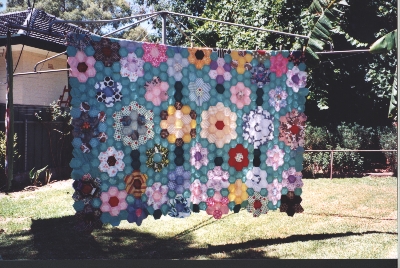
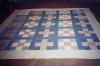
Hexagon quilt made from dressmaking scraps from one neice. The quilt top only is complete and a few papers are still attached.
2250 x 2000mm
History: 

This hexagon quilt top was made by Clara Pitt in South Australia in the 1960s. It is now owned by Helen Sparkman who is the great neice of Clara May Pitt.

Story: 

"Clara made many quilts, mainly during the 1950s and 1960s, not out of need but because of her love of patchwork. Her quilts were mainly Hexagons and Suffolk Puffs. Clara was a single lady who had five neices and a nephew, and quite a number of great neices and nephews. As each quilt was completed it was presented to a family member. These family members now cherish her gifts, even though all have often smiled and queried her fabric selection, placement, neatness and her continual use of white thread over the years. Clara was over 80 years of age when she made her last quilt (Hexagons of course!) for a private Museum."
[Helen Sparkman Dec. 2000]

Related Quilts:
National Trust of Australia (WA)
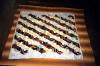
Frame quilt of dress cottons, including some glazed cottons. The centre is 4 triangles pieced to make a rectangle. This is surrounded by a plain border, a border of triangles, plain border, triangles border, plain border, border of triangles pieced to form squares, square and triangle border, then rows of squares. The outer border is of glazed floral chintz with a brown background. The backing is cream linen pieced lengthways in 3 sections. There is no padding. It is quilted all over in a large clamshell pattern. The top is covered with netting.
2615 x 2280mm
Arapiles Historical Society Museum
Patchwork quilt, reversible, with log cabin blocks on one side, with central red square in each block. Colours predominantly light greys, browns and pastels, and dark grey and blue. Reverse side is made of squares constructed from 2 triangles, in black, patterned pastels, pale blue and dark red. There is a black border along 2 edges on this side. It is quilted.
2058 x 1829mm
National Gallery of Australia
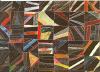
" A wide range of cotton fabrics have been used to make this quilt in the traditional log cabin style. The strips of the log cabin are joined by rows being hand sewn onto a small square backing fabric, each square of strips has then been hand sewn together to form the quilt. The work is backed with a sateen printed fabric decorated with paisley design. A strip of the lining trims the edge of the front face of the quilt. The lining is attached with machine stitching. There are numerous tacking stitches that remain in the front face of the quilt. There are approx 9000 pieces in the quilt, most being only 5mm in width.
The quilt is of three layers because the strips of the log cabin are attached to a backing piece, and then the quilt is lined; however it is not padded." [NGA]
Josephine Curtis
Taylor's sample quilt made from men's suit swatches, mainly greys and blues. Edging is 6cms wide, of blue flannelette. Padding is an old grey blanket, and the backing is of printed pattern corduroy. 1680 x 920 mm.
Ann Hockey
Patchwork quilt made from rectangles of samples of men's woollen suitings, in greys and blues and some browns. The rectangles were machine sewn together and then sewn in rows or strips. Originally the quilt had a rabbit skin backing, removed due to deterioration. No padding. Machine sewn.
1550 x 1420mm
The Embroiderers' Guild of S.A.Inc Museum
Wholecloth quilt in white cotton voile with alternating designs of Australian wildflowers worked in multi coloured cottons and shadow work. It is backed with yellow voile. There is no padding.
2010 x 1910mm