
Quilt No.654JL - Joyce Lloyd

Description:
Hand pieced quilt of mainly cotton hexagons with 7 forming a 'flower' in a pattern often called 'Grandmother's Flower Garden'. The backing is glazed chintz and the padding is American polyester.
3000 x 1430mm
3000 x 1430mm
History:
Made by Joyce Lloyd c.1970 and owned by her. It was started in Canberra and worked on while travelling on the motorways in England and Scotland with her husband Peter.
"This quilt was begun in Canberra while Peter (my husband) was head of the UK scientific services in Australia, that was Woomera and other testing sites. I joined the Canberra diplomatic corps quilters group and began my scrap quilt. I took the quilt pieces to America on our trip home to UK. I ran out of reading material and sewing material and asked my husband if I could have his pyjama leg bottoms. He said 'no, but you can have my snuff handkerchief instead'."
[Joyce Lloyd 26.4.98]

Joyce Lloyd 1998
Related Quilts:
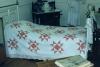
Patchwork quilt has pieced blocks in the 'Ohio star' pattern in red print and white cotton, alternating with plain white blocks. Quilt has a 9cm frill in red and grey geometric print cotton, machine stitched around the edge. Quilt appears to have some hand quilting. No padding. Backing is white cotton.
2210 x 2060mm
2210 x 2060mm
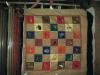
A 'Farm Life Quilt' made from alternate squares of beige linen and brightly coloured cotton headcloth. The coloured squares are farm animals and birds in a variety of embroidery stitches. The beige squares have a cornucopia design embroidered in dark brown stem stitch. There is a wide border front and back of beige linen. The backing is brown and white check cotton. There is no padding.
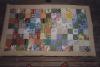
Machine sewn quilt made from 125mm squares of scraps left over from dressmaking joined in strips and then the strips joined. There is a border of fawn cotton and the backing is the same material. The padding is an old blanket and the border is padded with sheep's wool.
1400 x 925mm
1400 x 925mm
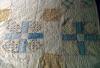
Patchwork quilt, all cotton including cotton padding. Pattern is based on squares and a cross. Variety of fabrics, plain and patterned. Hand stitched and quilted.
2083 x 1626mm
2083 x 1626mm
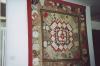
The quilt consists of a central field within a main field within a narrow border a main border and then an outer border. The centre field consists of embroidered Prince of Wales feathers with 4 embroidered motifs, parrot, duck, open fan and 4 playing cards within an appliqued sunburst border. The quilt has many embroidered and appliqued motifs, some just abstract shapes, many with a Chinese Japanese theme. It is quilted and padded but the type of padding is unknown. The backing is red cotton sateen.
2280 x 2240mm
2280 x 2240mm
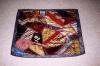
Small patchwork piece in crazy patchwork in silks, satins, and velvets. Embroidered initials 'A.N' also an embroidered crest, the date 1869 with initials 'A.W.N'. There is also decorative stitching over the joins of most pieces. It is not padded. The backing is Jacquard.
661 a 649mm
661 a 649mm