
Quilt No.301ASA - Art Gallery of South Australia

Owner:
Art Gallery of South Australia
Location:
SA Adelaide
Maker
Maker:
Henretta Stanton
Made in
ENGLAND
Patterms
Date:
1851 - 1880
Description:
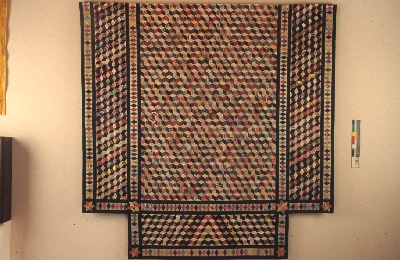
Patchwork quilt in the Tumbling Block pattern in light and dark silks in bright colours. On both sides and at the bottom is a wide border in Tumbling Blocks, the pattern vertical at the sides and forming a triangle centre bottom, with an edge on both sides of two black bands with pieced diamonds between. Made for a poster bed. Hand sewn.
1790 x 1750mm
1790 x 1750mm
History:
Made by Henrietta Stanton (born Rodwell), in Norfolk, England, c.1860s-1870s. Given to the maker's youngest child, and her daughter, by an aunt in England in 1949. Donated to the Art Gallery of South Australia, Adelaide, in 1977 by Miss C. Magarey.
772A74
Story:
Henrietta Stanton was born in London in 1840, daughter of a jeweller, marrying William Stanton around 1862. She and her husband both died in 1925. The quilt was made in Norfolk, England, and donated to the Art Gallery of South Australia by the maker's grand-daughter, whose mother was the youngest of Mrs. Stanton's ten children. It was given to the donor and her mother by an aunt when in England in 1949.
Related Quilts:
Cotton quilt made in the USA. The pattern is 'Double Irish Chain'. It is machine pieced and hand quilted. The backing is calico and the padding is cotton,
2134 x 2134mm
2134 x 2134mm
"This quilt follows the traditional hexagon patchwork pieced pattern, which are then joined and sometimes edged with a contrasting border. The edges of the quilt have been turned and then scalloped edges made of identical patches to the main body of the quilt have been attached to the edge. The quilt is fully lined, and the lining is visible front the front face through the gaps between the scalloped edge. The lining is attached to the patchwork with a row of stitches along the edges; there are no stitches in the centre field. The fabrics of the quilt are plain weave cotton in simple floral and geometric designs. Most of the fabrics are monochromatic. Several different colour ways of the same fabric are evident which could suggest some fabrics were from manufacturer samples. The lining is a William Morris print.
Each of the patchwork pieces (there are several thousand present) are sewn together with very fine overcasting stitches. The quilt is entirely hand sewn. There is some evidence that templates from the hexagon pieces possibly blotting paper, remain in situ���The quilt is not padded or quilted. The lining is fine twill weave cotton printed in pink and pale purple. The design follows William Morris's 'Strawberry Thief design'." [NGA] 2075 x 1911mm
Each of the patchwork pieces (there are several thousand present) are sewn together with very fine overcasting stitches. The quilt is entirely hand sewn. There is some evidence that templates from the hexagon pieces possibly blotting paper, remain in situ���The quilt is not padded or quilted. The lining is fine twill weave cotton printed in pink and pale purple. The design follows William Morris's 'Strawberry Thief design'." [NGA] 2075 x 1911mm
Double sided quilt made from woollen suiting pieces some of which have hand worked eyelets. Many of the rectangles are irregular. Both sides use similar pieces but arranged in different patterns. There is no padding.
2160 x 1524mm
2160 x 1524mm
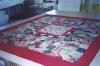
Frame quilt, hand and machine sewn, centre square of squares (7 rows by 7 rows) of 2 triangles, with red border. Alternate rows of triangles, rectangles, 'flying geese' border, squares, squares set on point with triangles, wide red border. Hand quilted throughout in chevrons, single cables and single scallops. The padding is a hand woven cream wool blanket and the backing is cream cotton twill.
2330 x 2030mm
2330 x 2030mm
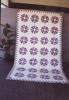
Pieced repeat block in 'Dresden Plate' pattern in a variety of fabrics with pink and pale blue predominating. Scalloped outer edge. Machine pieced and hand quilted, with echo quilting of four petals between the 'Dresden Plates'. The padding is polyester, and the backing is white calico. 2600 x 1630 mm.
Patchwork quilt made from squares and rectangles of pink, blue and white fabric set with a frame of pink and white print around a centre rectangle made of 4 pink triangles. Four corner squares of blue and white stripes, Many squares are pieced from smaller scraps. The Material is a crepe type, possibly used for underwear. Handsewn and machined. Backing is made from cotton scraps, possibly lawn or similar. Padding is flanellete or similar. Edges are bound in a striped material. Quilt shows signs of wear.
620mm x 520mm
620mm x 520mm