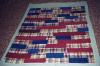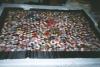
Quilt No.450PS - Pat Stevenson

Pat Stevenson
Owner: 
Pat Stevenson
Location: 
VIC Melbourne
Maker
Maker: 
Elsa Beavis
Made in
AUSTRALIA VIC
Date: 
1941 - 1970
Description: 
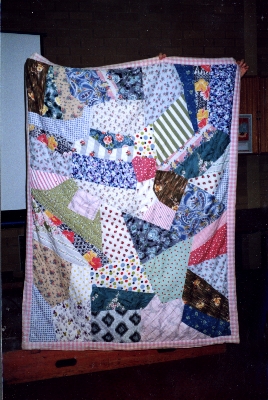
Crazy patchwork stitched on to an old sheet. Machine constructed with 2 sides similar. It is made from left over dressmaking materials of the fifties. The 2 sides with cotton wadding in between are bound together with a 55mm pink and white gingham binding.
1803 x 1398mm
History: 

This quilt was made by Elsa Beavis in Melbourne for Pat Stevenson in 1958/59. It is still owned by Pat Stevenson and is still used.

Story: 

" Elsa Beavis was the needlework teacher in charge of the subject at Flemington Girls School in 1958 when I started teaching there in 1958. Elsa had made a similar quilt for another staff member and when requested agreed to make one for me.
I was to provide the materials. So I gathered fabrics left from my dressmaking, my students dressmaking, and pieces collected from my working time in the dress trade 1954 and 1955 at a sportswear and casual clothing factory. My mother provided the 2 old worn sheets that form the backing to the patchwork.
Elsa Beavis was a lady who did all types of needlework. I had done much embroidery but never met cross stitch and traditional forms of counted thread work, to which she introduced me.
Of a Norwegian extraction, she made exquisite traditional folk dress for dolls with the traditional decoration. Many prizes were won by her at the Royal Melbourne Show in the years I knew her.
She later married a widower and became Mrs. Elsa Williams, living at Gladysdale and teaching at a High School in Yarra Junction Victoria. Unfortunately I lost track of her, but I owe her a lot, as my mentor, to the wider world of textile arts."
[Pat Stevenson 14.3.98]

Related Quilts:
Mare Carter
Patchwork quilt with diagonal arrangement. All cotton including cotton padding. Hand sewn and quilted.
2109 x 1702mm
Pauline Hunter
Patchwork quilt made from hexagon patches in satin and nylon, the nylon overlaid on satin. Fabrics are plain, in a mixture of dark and light colours. No padding. Backing is of pink satin with pink satin ribbon covering the joining seams. Hand sewn with some machine stitching. Feather stitching along the edge. There is no padding.
2211 x 1752mm
Queenscliffe Historical Society Inc
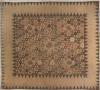
Patchwork quilt made of 1 inch hand paper pieced hexagonal patches (English technique), with plain and floral patterned blue fabrics in clusters at regular intervals throughout the taupe coloured patches. Centre of quilt has a cluster or 'flower' of 4 rings of patches, the centre group embroidered in blue satin stitch: 'MW 1938'. Border consists of 3 rows of medium, light and dark blue hexagons. No padding. Backing is of blue cotton sateen.
2185 x 1372mm
Queen Victoria Museum and Art Gallery
Patchwork quilt made from diamond patches in a variety of cotton materials set in a 'tumbling block' pattern. Patterns include geometrics, stripes, a 'Kate Greenway' print and colours are largely soft pastels, dark browns, with some reds and blues. The quilt has been cut down and a later border added. There is no padding and the backing is cream cotton.
2279 x 2000mm
National Gallery of Australia
" A wide range of cotton fabrics have been used to make this quilt in the traditional log cabin style. The strips of the log cabin are joined by rows being hand sewn onto a small square backing fabric, each square of strips has then been hand sewn together to form the quilt. The work is backed with a sateen printed fabric decorated with paisley design. A strip of the lining trims the edge of the front face of the quilt. The lining is attached with machine stitching. There are numerous tacking stitches that remain in the front face of the quilt. There are approx 9000 pieces in the quilt, most being only 5mm in width.
The quilt is of three layers because the strips of the log cabin are attached to a backing piece, and then the quilt is lined; however it is not padded." [NGA]
Gillian Sullivan
Quilt made of 9120 very small Suffolk Puffs, each one about the size of a 20 cent piece. "Each piece backed and the front of it drawn up like a reticule. It was not backed and was rather fragile, so I backed it on to a sheet, as it was heavy and in danger of tearing when lifted." [Gillian Sullivan]
2360 x 2230 mm