Quilt No.555NPW - N.S.W. Parks and Wildlife Service
N.S.W. Parks and Wildlife Service
Owner: 
N.S.W. Parks and Wildlife Service
Location: 
NSW Sydney
Maker
Maker: 
Sarah Marshall?
Made in
AUSTRALIA NSW
Date: 
1901 - 1920
Description: 
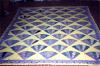
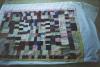
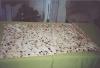
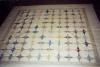
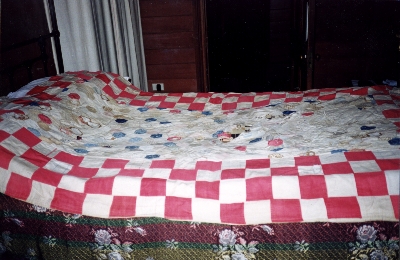
Large centre rectangle of hexagons in various colours of patterned and plain cottons. It is surrounded by a wide border in a checkerboard of red and white cottons. There is a wholecloth cotton backing. The front and the back have been turned under at the edge and machined. There is no padding.
1829 x 1372mm
History: 

At this time it is impossible to make a definite attribution to Sarah Marshall but this quilt was almost certainly made by Sarah Marshall and/or one of her daughters, Hannah, Jean or Agnes at Hill End NSW and probably at 'Craigmoor' their family home. The exact date is unknown. It is now part of the 'Craigmoor' collection owned by the NSW National Parks and Wildlife Service and displayed at 'Craigmoor'.

Story: 

James Marshall (1828-1905) from Scotland via the Californian gold rush and Sarah Langslow Adams (1836-1926) born Herefordshire England, were married in 1858 at Hill End. Reef mining in the 1860s brought fame and fortune to this mining settlement, north of Sofala and Bathurst in NSW.
In 1875 James Marshall had 'Craigmoor' built and he and Sarah lived there with their family of 9 children, 2 having died in infancy.
The textile collection at 'Craigmoor', including the quilts, reflects the Marshall women, Sarah and her daughters Hannah (1859-1950), Jean (1867-1948) and Agnes (1871-1950) and gives a glimpse of the daily lives of the women. Needlework, including crochet, in various forms was important and some of the women made their own hats. At least in the later years it appears to have been a thrify household with many quilts made over and patched.
Hannah, a spinster, lived at 'Craigmoor' from the time it was built until her death aged 91. She taught Sunday school in Hill End and was well know locally for her bottling, preserving and jam making. She also made elderberry wine. The 3 sisters were fond of playing the piano.

[Sources: N.S.W National Parks and Wildlife Service brochure on Hill End, Sue Stephens daughter of Charles Marshall, Christine Karlsen, informal conversations with the locals at 'The Royal'. Wendy Hucker for NQR]

Related Quilts:
The Temora Rural Museum
All cotton hexagon quilt using a wide variety of colours and patterns. The hexagons were hand stitched by Sylvia Schleibs in the same style she and her daughter, Norma Gilchrist, had previously made 3 hexagon quilts. There is a calico border and backing.
2000 x 1450mm
Albury Regional Museum
Patchwork quilt or cloth made from pieces of woollen material used for regimental uniforms in England last century. Star pattern in colours, red, pale blue, green, maroon, yellow [white] and brown. Hand pieced probably by more than one person. Red fringe machined on. Red flannelette backing in poor condition. Two layers, not quilted.
1780 x 1700mm
Alison Tunney
Quilt in mauve, pale blue and white squares, with wide borders of floral and off white. The quilting is a centre medallion with leaves on the border, and cross hatched over all. The padding is cotton batting, and the backing is plain white cotton. 2180 x 1900 mm.
Teona Smith
Suffolk Puff or puff-ball quilt is made from scraps of dresses and pyjamas, mainly cottons, but also taffeta lining fabric, net, lurex, flocked organdie. The quilt is in bright clear colours, the fabric mostly in small prints, ginghams, different size spots, a few large prints, Chinese brocade, nylon. Puffs are 5cm across, and set 31 puffs across by 45 down. Puffs are squared off when whipstitched together, so corner holes are smaller than usual.
2180 x 1500mm
National Gallery of Australia
"This is not a true quilt, but a pieced coverlet with a lining. The entire front face of the quilt is of pieced hexagonal and part hexagonal printed cotton patches. Pieces are joined with hand sewn over casting stitches of many different coloured cotton threads. The joining of the patches forms a 'daisy' pattern in some areas and in others it is random. The edge of the front face of the quilt carries a 40mm strip of cotton Chinoiserie which is then folded to the reverse of the quilt and becomes part of the lining. The template for the hexagon patches remains in many of the patches: writing paper and news print." [NGA]
The work is not padded "The lining at the edge of the quilt (for approx.175mm) is a plain weave fabric of a Chinoiserie design. The centre field of the lining is a rectangular panel of a twill weave brushed cotton fabric with a striped floral design." [NGA] 2215 x 2070mm
Busselton Historical Society
The strip quilt is handsewn and quilted. Quilt top has 13 panels or strips of 3 different cotton lawn floral prints. Some fabrics are now wearing. Backing is of plain white cotton. The padding is wool. Quilting features a triple row cable design with flower motifs.
2100 x 1800mm