Quilt No.621PWH - The Pioneer Women's Hut

Owner: 
The Pioneer Women's Hut
Location: 
NSW Riverina
Maker
Maker: 
Agnes Chitty
Made in
AUSTRALIA Vic
Date: 
1901 - 1920
Description: 
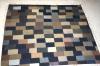
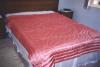
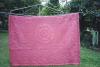
Wholecloth quilt with top and backing of green and pink floral cretonne. The padding is machine pieced patches from old woollen blankets.
1440 x 1070mm
History: 

This is typical of many quilts made by Agnes Chitty at Tintaldra for general use on beds in their home. This one was made c.1914. It was owned by her daughter Eleanor Meredith and donated to The Pioneer Women's Hut by Agnes' son-in-law Claude Meredith. It is occasionally displayed at the museum.

Story: 

Agnes Chitty (1857-1934) was born Agnes Kersey in the Beechworth district of Victoria. Her mother Maria and father William were both English and William was a miner looking for gold. In 1862 Maria and her daughter Lydia both died and in 1868 William Kersey died probably in a mine explosion. Agnes was then 11 years old and her sister Isabella 9 and they were taken in by Eliza Dunn who was the owner of the Freemason's Arms Hotel, Deep Creek, Victoria.
Phillip Chitty was born in Van Diemen's Land in 1843 and came via the goldfields to Walwa Victoria where he was an overseer for Grandison Watson who had the Walwa run. In 1875 Agnes and Phillip were married and went to live on the Mundaroo part of the run called 'No Place'. They had 3 children there and another 9 when they moved to Tintaldra, Upper Murray, Vic.
[Source: "Memories of my Mother" 1990 The Pioneer Women's Hut]

Agnes was a fine needlewoman and a keen gardener: " Grandfather Phillip's orchard was an amazing affair of grafted trees, vines and such fruits as Granny Smith Apples, Jonathan Apples and Northern Sky variety on one tree. As well he had Green Gage and Rosa plums on one tree. He also had sweet water grapes and black Muscatel grapes on one vine etc.
Grandma Agnes garden was just as amazing. A sea of red hot pokers in an old swamp, surrounded by catmint, yellow castor oil, roses, red cabbage roses, cream banksia climbing roses and nearby grew the biggest apricot tree, bowed down by 'dead ripe' fruit I have ever seen, and also I remember not being able to eat the aprictos for a long time after much feasting on the very ripe fruit. Gran would always identify the roses in the garden by name and was able to grow almost anything, having the proverbial Green Thumb. The bleeding heart plant was another of her specialities."
[Mavis Carruthers, grand-daughter, "Memories of my Mother" 1990 The Pioneer Women's Hut]
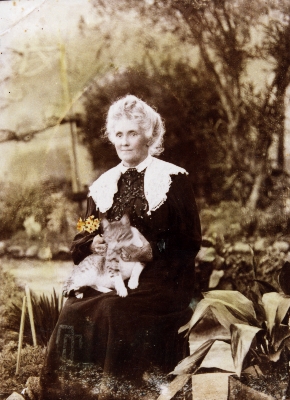
Agnes Chitty with Gilbert the cat, c.1910
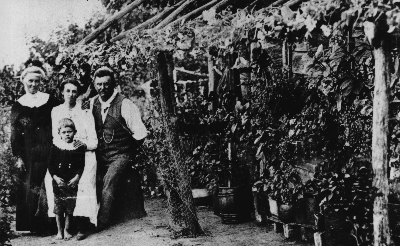
Agnes Chitty (left) with family members, Tintaldra 1913
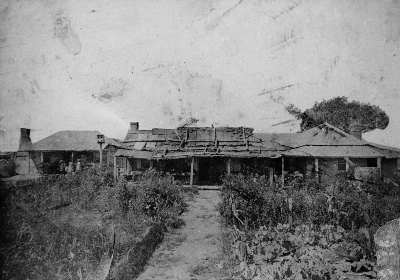
'No Place' near Tumbarumba NSW c.1890

Related Quilts:

Yvonne Hamdorf
Wholecloth pram quilt with a top of pink cotton sateen, and the reverse is a more finely woven, ivory, fabric. All over quilting design as main feature, with stylised hearts, leaves and cross hatching. The padding is cotton batting. 870 x 660 mm.
John Tomkin
Hand stitched, cotton, appliquéd, quilt in a flower pattern on a plain background. Colours are shades of green, apricot and browns. This quilt was known as a 'Bride's Quilt'. Padding is thought to be layers of white fabric raised almost like a wadding. The backing is cotton material. 2470 x 2020 mm.
Inverell Pioneer Village
Wholecloth quilt made of red floral crinoline cotton material. Quilting is in vertical rows, alternating cables with orange peel patterns. Padding is of cotton flock. Backing is of white cotton. Quilt is edged with a self fabric ruffle on three sides. Hand sewn.
2236 x 2236mm
Powerhouse Museum
"A quilt or coverlet of natural cotton sheeting with appliqueed motifs cut from a variety of crimson cotton damask. The quilt is hand sewn and nearly square and has a 12 cm border made from the same crimson damasks. The applique motifs consist of a range of hexagons, rosettes, flowers, hearts and stars that radiate outwards from a large centrally placed star shape. All are the same shade of crimson red which suggests they were dyed in the same dye pot. The fabrics are now quite thin and soft which suggests that the quilt, or the fabric it was made from, was well used." [PHM]
1960 x 1950mm
Tasmanian Museum and Art Gallery
Machine sewn reversible quilt. Side 1 is rectangles of men's suiting samples in mainly grey, navy and black, stripes and self patterns. Side 2 is men's suiting samples but also includes woollen rectangular pieces in plain blue and deep pink. There is a hand sewn binding of fine orange-brown wool. The padding is hessian and cotton.
1460 x 1100mm
Griffith Pioneer Park Museum
Wholecloth quilt, yellow sateen both sides. Hand quilted in geometric and curvilinear patterns. Edges turned in, hand finished. Stuffed with flock-like material said by the donor to be wool. Approximately 2.5cm thick.
2500 x 2000mm.