
Quilt No.772PHM - Powerhouse Museum
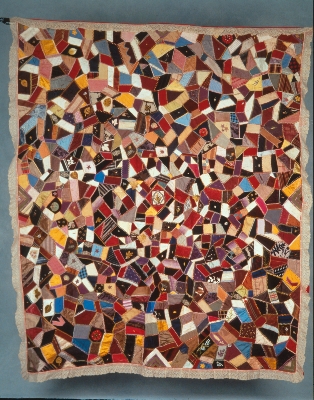
The backing is a "cotton patchwork print with an asymmetrical design of playing cards, paisley, checks and geometric patterns in green, red and blue on a white background." [PHM]
The quilt is padded with a wool and cotton blanket.
2275 x 1935mm
The quilt was made by Marion Gibson on a property near Hay NSW and completed in 1892. Marion left the quilt to her eldest grand-daughter. It was then passed down the female line of the Gibson family. It was acquired by the Powerhouse Museum in 1990, with the assistance of funds provided by the Gibson family.
".....Marion Gibson was born in Scotland, the daughter of a tailor. In 1854 she married John Gibson, a bootmaker, and they sailed for Australia. The settled in Coolac where John set up business as a bootmaker until, in 1875, fulfilling a lifetime ambition to take up farming they bought a property, 'Narringa', outside Hay and there Marion Gibson established a home for her family, which eventually grew to nine children, eight boys and one girl. In addition to her work in the home and her activities on behalf of rural settlers generally, Marion Gibson was known for her skills as a needlewoman and this is only one of a number of pieces by her that survive." [PHM]
"This is a rare example of a nineteenth century quilt that is not only well provenanced but whose maker has left a detailed description of its construction, materials and the reason for making it. In a letter to her grand-daughter, Marion Gibson wrote...'With the exception of a few scraps of ribbon it was all made up with pieces [sic] from friends far and near. I called it the Friendship quilt and to me it was a labour of love and given to you as my eldest grand-daughter...I am sorry I cannot write a history of it - for as the eye is dazzled by the many colours of the different bits, so the mind is puzzled by the loving memories of dear friends who contributed and took an interest in the Friendship Quilt.....I must add I spent many a happy hour on it.'
The pieces came from wedding dresses, men's ties, children's clothes, favourite ribbons, bonnet trimmings and other personal items. There is even a piece from the crown of a neighbour's hat, 'which I did not care for, but put on to please him.' As Marion Gibson concluded, 'I went in for "Federation" on this quilt - for all classes are united.' " [PHM]
Related Quilts:
2143 x 2090mm
1525 x 1220mm
2286 x 915mm
2743 x 1829mm
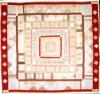
The quilt is not padded. The patchwork is fully lined with a printed plain weave cotton fabric with a design commemorating Queen Victoria's Jubilee. The design is based on a repeated grid of circles. In the centre of each circle is a cameo of Queen Victoria, surrounded by images of the national flowers of England, Scotland and Ireland: the rose, the thistle and the shamrock. The edge of the front face of the quilt is trimmed with a red and white cotton braid." [NGA] 2380 x 2220mm
1880 x 1728mm