
Quilt No.598PWH - The Pioneer Women's Hut
Owner:
The Pioneer Women's Hut
Location:
NSW Riverina
Maker
Maker:
Eletha Fagg
Made in
AUSTRALIA NSW
Date:
1901 - 1920
Description:
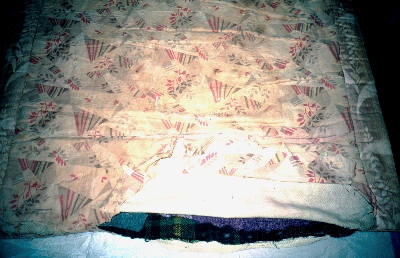
The top is a wholecloth piece of twill type cotton and the backing is a wholecloth piece of finer patterned cotton. The padding is a layer of pieces of used clothing stitched together, including part jumpers, some darned. These are inside an old folded blanket.
1540 x 950mm
1540 x 950mm
History:
This utilitarian quilt was made by Mrs. Eletha Fagg at Lankey's Creek NSW c.1920. Her son Keith donated it to The Pioneer Women's Hut. It is displayed occasionally in the museum.
Story:
This quilt was in continuous use on beds at Lankey's Creek until post war and then at Keith's house at Mannus, NSW until about 1970. It was then used on a bed between a mattress and a wire base to 'stop the draughts'.
Related Quilts:
Wholecloth pram quilt with a top of pink cotton sateen, and the reverse is a more finely woven, ivory, fabric. All over quilting design as main feature, with stylised hearts, leaves and cross hatching. The padding is cotton batting. 870 x 660 mm.
Hand stitched, cotton, appliquéd, quilt in a flower pattern on a plain background. Colours are shades of green, apricot and browns. This quilt was known as a 'Bride's Quilt'. Padding is thought to be layers of white fabric raised almost like a wadding. The backing is cotton material. 2470 x 2020 mm.

Wholecloth quilt covered front and back with the least worn parts of old curtains. The padding is a carded wool sheet from Ipswich Woollen Mills placed between layers of cheesecloth.
1800 x 1225mm
1800 x 1225mm
Wholecloth quilt made from floral cotton material with a light green background. Hand stitched quilting pattern of diamonds in the centre and parallel lines radiating out from this. The padding is cotton wadding.
1940 x 1300mm
1940 x 1300mm
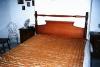
Wholecloth quilt of golden brown cotton sateen, the backing of a lighter yellow cotton sateen. Hand quilted with an allover repeatingr pattern of a cross within a square. The border is quilted with 4 parallel rows of stitching at the sides, and 5 at the top and bottom. Padding is cotton wadding. 1920 x 1440 mm.
1920 x 1440mm
1920 x 1440mm
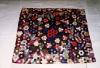
Patchwork quilt made from hexagon patches of cotton, silk, brocade, sateen and wool. Some silk patches are individually lined. Colours are mainly red, blues, purple, black, yellow and brown, with some pastels. Many silk patches have disintegrated, showing the paper templates. Quilt has a brown cotton inner lining, then a blue cotton backing, and is edged on the reverse with checked silk. Hand sewn by more than one person: one experienced sewer, one not so experienced.
1370 x 1170mm
1370 x 1170mm