Quilt No.88DS - Dorothy Stevens

Dorothy Stevens
Owner: 
Dorothy Stevens
Location: 
QLD South West
Maker
Maker: 
Emmiline Marsland
Made in
AUSTRALIA QLDt
Date: 
1940 - 1970
Description: 
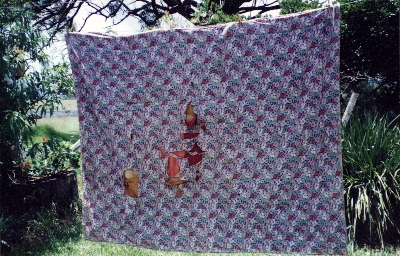
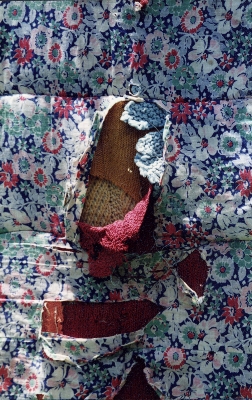
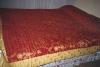
Utilitarian quilt. Padding consists of recycled hand knitted jumper pieces (mainly 3 ply crepe and 8 ply) tacked to a layer of cotton material with strong buttonhole twist thread. The top is a piece of cotton fabric. Machine quilted in rows approximately 70mm apart.
1827 x 1423mm
History: 

The maker was Emmiline Marsland in Roma, Queensland in the early 1950s. It was given to her friend, Dorothy Stevens, the present owner, in about 1978.

Story: 

Emmeline was a steward at the ECCA (RASQ Show) before moving to Roma to care for 2 motherless children. She remained unmarried but adored children, stitching children's clothes for the various adopted families over a 30 year period.
"Emmiline Marsland was my very dear friend. I boarded with her when teaching in Roma in 1952-53. She was born 30th July 1901 and died 18 December 1986. A dressmaker by trade , she was skilled in many crafts, fine embroidery to woodwork and had a great love for children. I remember sleeping under the green quilt in Roma and it was probably used for packing precious furniture when moving form Roma to Maryborough to Brisbane."
[Dorothy Stevens 18.3.1996]
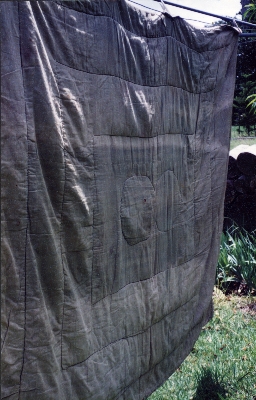
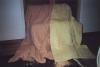
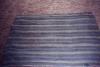
Back of quilt
Back of quilt
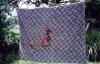
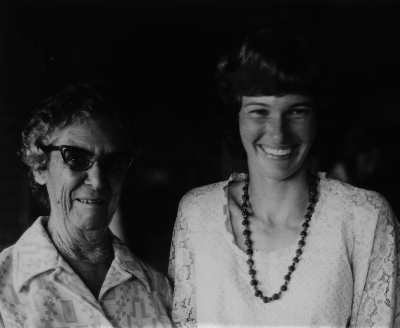
Emmiline Marsland & Phillipa Harvey(Stevens)1978

Related Quilts:

Yvonne Hamdorf
Wholecloth pram quilt with a top of pink cotton sateen, and the reverse is a more finely woven, ivory, fabric. All over quilting design as main feature, with stylised hearts, leaves and cross hatching. The padding is cotton batting. 870 x 660 mm.
John Tomkin
Hand stitched, cotton, appliquéd, quilt in a flower pattern on a plain background. Colours are shades of green, apricot and browns. This quilt was known as a 'Bride's Quilt'. Padding is thought to be layers of white fabric raised almost like a wadding. The backing is cotton material. 2470 x 2020 mm.
Annette Gero
This domestic Wagga is two layers of woollen army blankets with the top layer in rectangles joined in rows. The backing is hessian bags that originally contained meat meal.
11650 x 1130mm
National Gallery of Australia
" Reversible patchwork quilt of woollen suiting in grey, blue, navy, maroon and brown. The fabrics appear to be new tailor's sample pieces (the sizing is still present on the fabric, signifying it has never been washed). The patches are rectangular and vary in size. Both sides have different designs. The front of the quilt has 4 rows of 12 vertical rectangles then below this are 4 rows of 7 horizontal rectangles followed below by 4 rows of 11 vertical rectangles. The reverse of the quilt has a section at the top and bottom composed of 5 rows of 9 horizontal rectangles. The central area is made up of a centre section of 6 rows of 5 vertical rectangles; flanked on either side by a column of 10 horizontal rectangles and two columns of 8 smaller vertical rectangles.
The patchwork layers are joined at the edges with machine stitching. The patchwork layers and padding are machine quilted on the front down 2 vertical lines following joins in the patchwork; therefore not being totally straight. The lines are more noticeable on the reverse as the 2 sides do not match. The front face is displayed at the NGA.
Between the patchwork layers is a striped cotton blanket in black, sky blue, white and cream." [NGA]
2082 x 1386mm
Ann Hockey
Patchwork quilt made from rectangles of samples of men's woollen suitings, in greys and blues and some browns. The rectangles were machine sewn together and then sewn in rows or strips. Originally the quilt had a rabbit skin backing, removed due to deterioration. No padding. Machine sewn.
1550 x 1420mm
Alysoun Ryves
Red Applique on an off white background. All applique is by hand using herringbone stitch. Three different red materials are used for the applique each printed with a different tiny all over pattern. There are 3 different applique shapes: the 9 major shapes have 8 points; the daisy pattern has 8 petals; the edge pattern is used along the top, left and half of the bottom edge of the quilt and sometimes has 4 points, sometimes 3 and sometimes 2. There is a tiny red piping around the quilt along the bottom and both sides. It is hand quilted in 100mm long zig zags 12mms apart all over the quilt. The quilt is signed twice on the front, once in ink and once in embroidery. It is signed 'Anna Edwards Jan 1858'. There is no padding and the backing material is similar to the off white background material of the top.
2270 x 2180mm