
Quilt No.430DW - Darling Whitehouse
Description:
The quilt is made from pure silk scraps from Queen Victoria's dresses. The owner estimates there are about 4000 diamond shapes. There is a square of yellow silk as a centrepiece with the initial 'W' on it.
2033 x 1829mm
2033 x 1829mm
History:
The quilt has been owned by William Wellesley-Whitehouse, Stuart Wellesley-Whitehouse, Michael Wellesley-Whitehouse and now Dominic Wellesley-Whitehouse but held by his mother Darling Whitehouse. It is still used occasionally but is usually stored in a cupboard.
Story:
"The quilt was made by a lady at Queen Victoria's residence. She was a Wellesley and when she married a Whitehouse attached Wellesley to her surname. We are lucky to still have the quilt - Stuart's house was flattened during the war."
[Darling Whitehouse 2.4.98]
Related Quilts:
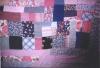
Cotton quilt made from squares of patterned and plain materials. It has a mauve cotton flounce around the border and a mauve cotton backing. There is no padding.
2700 x 1350mm
2700 x 1350mm
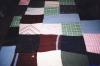
Double sided patchwork quilt/rug constructed from squares machined together in strips and then the strips joined. The squares average about 27cms. The materials are mainly woollens, fleck tweed, school jumpers, gren check, and chenille and all are from used clothing.
1800 x 1170mm
1800 x 1170mm
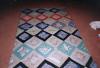
Quilt made from dressmaking materials in a design probably made up by the maker but resembling 'Courthouse Steps'. The outer border of each block is mitred. Originally it was reversible but during restoration the back was brought to the front, doubling the size of the quilt. The padding is old woollen materials. The backing is a new piece of floral material. It is now machine quilted.
1830 x 1220mm
1830 x 1220mm
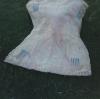
Patchwork quilt made from squares and rectangles of pink, blue and white fabric set with a frame of pink and white print around a centre rectangle made of 4 pink triangles. Four corner squares of blue and white stripes, Many squares are pieced from smaller scraps. The Material is a crepe type, possibly used for underwear. Handsewn and machined. Backing is made from cotton scraps, possibly lawn or similar. Padding is flanellete or similar. Edges are bound in a striped material. Quilt shows signs of wear.
620mm x 520mm
620mm x 520mm
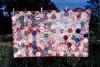
Hexagon quilt, hand sewn, using a wide variety of patterned and plain cotton scraps left over from dressmaking. 6 hexagons are placed around a centre one. There is no padding. The backing is brown flannel turned over to the front with hexagons hand stitched to it.
1220 x 763mm
1220 x 763mm
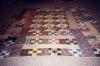
Medallion style all cotton quilt made in the USA. Hand pieced with centre panel of 'cheater' material pre printed in a patchwork design. Bordered with 'Nine Patch' and sashing. The backing is printed cotton and the padding is cotton. The quilt has yellow tufting or ties in wool.
1855 x 1525mm
1855 x 1525mm