Quilt No.1033NG - Narelle Grieve

Narelle Grieve
Owner: 
Narelle Grieve
Location: 
NSW Sydney
Maker
Maker: 
Unknown sailor
Made in
SHIPBOARD
Date: 
pre 1850
Description: 
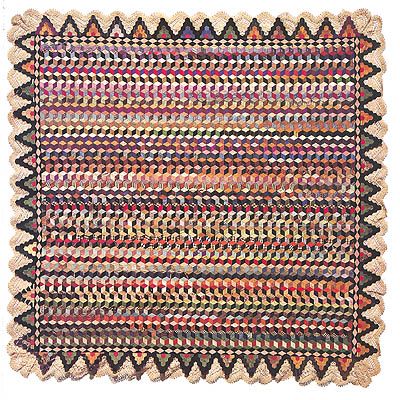
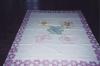
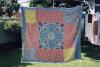
Silk quilt in diamonds with hexagon border. "Toward the edge of the quilt, the design of diamonds made into blocks offers an optical illusion, where the diamonds can be seen to form stars. The border is made up of these stars and half-diamonds, and the entire quilt is trimmed with lace and triangular flaps made of tiny hexagons." [extract unidentified magazine article supplied by quilt owner.]
The backing is maroon cotton. 1600 x 1600 mm.
History: 

The quilt was made by an unidentified sailor c.1846. It was given to Jane Williams of Somerset, England who backed it and sent it to Australia to Annie Smith, her sister-in-law in Sydney. It then passed by family descent to Annie's grandson, John Henderson of Middle Cove, Sydney from whom the present owner, Narelle Grieve, acquired it. It is not used.

Story: 

"It was not unusual for the European sailors of previous centuries to engage in the art of quilting. They needed to be able to sew in order to mend their sails, and quilting was a way of passing time while developing their sewing technique. Most sailors were talented needle people, as the fine stitches and intricate design of this quilt demonstrates.
Many of the lands which the sailors visited offered exotic fabrics and the silk used to make the tiny diamonds in this quilt may have originated in India. Papers still contained within the hexagons around the border of the quilt may be able to verify the origin of this fabric. This may also give some insights into the sailor's life and travels, but Narelle explains that she would have to unpick the backing to get to them and that could ruin the frail silk fabric." [extract from unidentified article supplied by the present owner.]

Related Quilts:
Gloria Martin
Double sided quilt machine made from clothing scraps. Shapes are mainly rectangles in corduroy and wool blend. The padding is an old grey blanket.
1524 x 1372mm
Peter and Jan Newman
Suffolk Puff quilt with puffs mainly in patterned cotton pieces saved from 60 years of household sewing. Puffs are formed into rosettes and the holes are on the top making a decorative feature. It is hand sewn.
2700 x 2400mm.
National Gallery of Australia
" This is an unfinished section/piece of crazy quilting. Ribbons divide the piece horizontally into three sections; between these are bands of pastel fabrics and embroidery in the crazy quilt tradition. The fabrics and threads employed are very luxurious: laces, satin ribbons and silk velvets. The embroidery is very fine, employing a wide variety of stitches and threads. This patchwork piece is padded with cotton wadding and backed with tarlatan." [NGA] 1170 x 1020mm
National Gallery of Australia
" Reversible patchwork quilt of woollen suiting/upholstery fabrics in khaki, greys, blues and browns. Both sides have different designs. The front of the quilt has 13 rows of 12 vertical rectangles flanked on either side by a column of 22 horizontal rectangles. The reverse has a more interesting and complex design of small and very large rectangles, squares and triangles; with khaki contrasting with the duller greys and blues. The patchwork layers are joined at the edges with machine stitching and the quilt is machine quilted along 3 horizontal lines following joins in the patchwork; therefore not being totally straight. These lines are more noticeable on the reverse. The reverse face has been on display at the NGA." [NGA] There is a cotton blanket used as padding. 2054 x 1451mm
Phyllis Dowling
Hand pieced cot quilt made from small rectangular shapes of a great variety of materials including cottons, silks, wools and velvets. The backing is cotton sateen in 3 colours and is brought to the front to form a border of pink, cream and yellow.
1170 x 920mm
Arlene Crane
Cotton patchwork quilt in double wedding ring pattern in pastel prints. Quilted in a design of geometric flowers. Padding is probably cotton wadding, backing is cream calico. 2270 x 1970 mm.