
Quilt No.617PWH - The Pioneer Women's Hut
Owner:
The Pioneer Women's Hut
Location:
NSW Riverina
Maker
Maker:
Julia Jeffries
Made in
AUSTRALIA NSW
Patterms
Date:
1881 - 1900
Description:
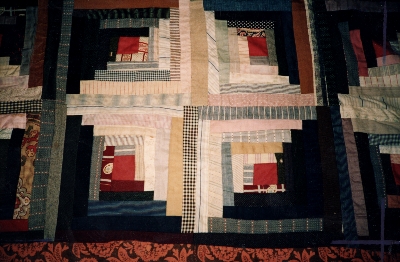
Machine constructed log cabin quilt using a wide variety of strips of used clothing including cottons, men's suitings and wools. Each square is about 250mm and arranged in the 'light and dark of the fire' variation of log cabin. There is no padding. The backing is brown twill with an orange pattern and is probably a replacement backing.
2180 x 1710mm
2180 x 1710mm
History:
The quilt was made by Julia Jeffries at Ournie on the upper Murray c.1900. It was handed down in the family by maternal descent and donated to The Pioneer Women's Hut by Bessie Hillis of Tallangatta NSW. It is displayed in the museum occasionally.
Story:
Julia Jeffries (1846-1919) lived with her husband Jabez at Ournie NSW. They had 11 children.
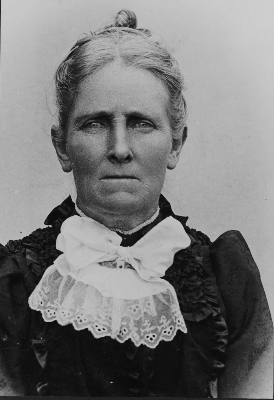
Julia Jeffries c.1900
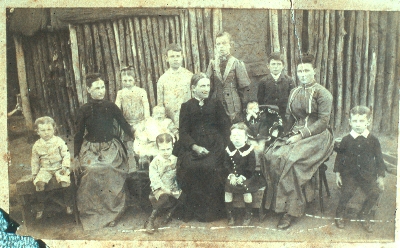
Julia Jeffries (centre in black) with the immediate family, Ournie NSW
Related Quilts:
Crazy patchwork quilt with patches of velvet, satin and silk joined in 12 blocks. Each seam is embroidered and many patches have embroidered flowers. There is a 140mm maroon velvet border. The backing is maroon silk. There is a sachet that belongs with the quilt.
1800 x 1400mm
1800 x 1400mm
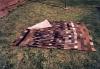
Patchwork quilt of rectangular wool and cotton tailors' samples, in browns, greys, navy, black and beige, in plains and patterned weaves. Padding is a woollen blanket, and the backing is a patterned cotton.
1956 x 1702mm
1956 x 1702mm
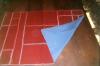
Patchwork knee rug made from maroon wool cut up from a garment into different sized rectangles. Pieced by hand, then all edges crocheted with coloured wool thread. The top was then machined and quilted to a pale blue wool backing. No padding.
1080 x 780mm
1080 x 780mm
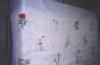
Wholecloth quilt in white cotton voile with alternating designs of Australian wildflowers worked in multi coloured cottons and shadow work. It is backed with yellow voile. There is no padding.
2010 x 1910mm
2010 x 1910mm
Quilt made from furnishing materials some with mettalic flecks. It is machine sewn.
160 x 135mm
160 x 135mm
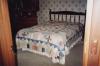
Patchwork quilt made from a variety of printed cottons over 70 prints, using shirting and dress fabrics, fabrics also from pyjamas, curtains, aprons, tablecloths. The centre medallion is a square within a square with white borders, the inner frame made of sawtooth triangles. This is surrounded by pieced triangles, square within a square and crosses. Outer frame of sawtooth triangles, and outer border pieced of squares and triangles. Colours are pinks, blues, burgundy and pastels, with floral, stripe and check prints. Lining of cotton. Backed with a printed cotton. Quilt is bound on all edges.
2430 x 2250mm
2430 x 2250mm