Quilt No.840AG - Annette Gero

Annette Gero
Owner: 
Annette Gero
Location: 
NSW Sydney
Maker
Maker: 
Jane Hope
Made in
ENGLAND Northumberland
Date: 
pre 1850
Description: 
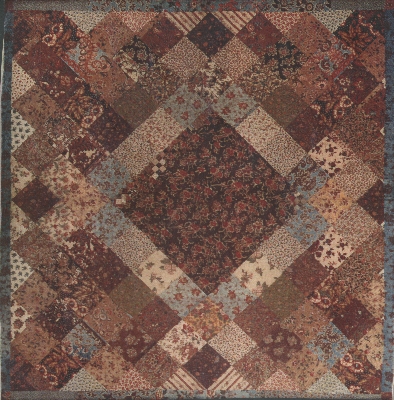
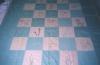
Hand pieced frame quilt with centre frame and borders of squares set on point. There is a blue patterned border. The backing is white and it is finely quilted. "The fabrics themselves are all absolutely typical of the period [1830 t0 1840] and many, if not most, of them can be found as illustrations in historical textile reference books - in this respect the quilt is virtually a book chapter in itself and has a particular value to a quilt historian. At about this period in England cottons and chintzes were being produced in great quantity and were relatively modestly priced." [Annette...
History: 

The maker was Miss Jane Temperley Hope and the quilt was made in Hexham, Northumberland, England c.1840. In 1932 it was sent to Mrs. A.E.Talbot who was related to Miss Jane Temperley Hope on the maternal side. It is now in the collection of Annette Gero.

Story: 

"The Sydney Morning Herald, Wednesday, July 20, 1932 'A Century Old Patchwork Quilt is Mass of Fine Hand Quilting and Old Fashioned Chintzes. Very proud of this marvellous patchwork quilt is Mrs.A.E.Talbot, wife of Dean Talbot. The quilt which is made of pieces of the loveliest of patterned and gaily coloured chintzes, has a plain white lining, showing an intricate and beautiful pattern worked in quilting. It was the work of one, Miss Jane Temperley Hope, in 1798-1800, who lived at Hexham, Northumberland, England, an ancestress of Mrs. Talbot's on the mother side, and has been in the family ever since. It was recently sent to her mother, Mrs. A. Vert, who has passed it on.' It was brought to Sydney in 1932. The fabrics themselves are a document of chintz available in the 1830s and 40s making this quilt an important historical record." [Annette Gero]

Related Quilts:
The Pioneer Women's Hut
Machine constructed log cabin quilt using a wide variety of strips of used clothing including cottons, men's suitings and wools. Each square is about 250mm and arranged in the 'light and dark of the fire' variation of log cabin. There is no padding. The backing is brown twill with an orange pattern and is probably a replacement backing.
2180 x 1710mm
Art Gallery of South Australia
Patchwork quilt in the Tumbling Block pattern in light and dark silks in bright colours. On both sides and at the bottom is a wide border in Tumbling Blocks, the pattern vertical at the sides and forming a triangle centre bottom, with an edge on both sides of two black bands with pieced diamonds between. Made for a poster bed. Hand sewn.
1790 x 1750mm
Bev Johnston
Patchwork quilt made from squares and rectangles of pink, blue and white fabric set with a frame of pink and white print around a centre rectangle made of 4 pink triangles. Four corner squares of blue and white stripes, Many squares are pieced from smaller scraps. The Material is a crepe type, possibly used for underwear. Handsewn and machined. Backing is made from cotton scraps, possibly lawn or similar. Padding is flanellete or similar. Edges are bound in a striped material. Quilt shows signs of wear.
620mm x 520mm
N.S.W. Parks and Wildlife Service
The top has a segmented circle in the centre surrounded by a border of small rectangles. The circle is featherstitched on to the background. Materials are wools and cottons and it is hand pieced. The other side appears to have been originally men's suiting materials strip pieced. It is now covered with a children's print in light cotton joined in long rectangles. The padding is coarse heavyweight cotton.
1410 x 1080mm
Marjorie Treasy
Machine sewn quilt made from 125mm squares of scraps left over from dressmaking joined in strips and then the strips joined. There is a border of fawn cotton and the backing is the same material. The padding is an old blanket and the border is padded with sheep's wool.
1400 x 925mm
Robyn Gallaway
Machine made cotton quilt with 100mm cotton squares placed diagonally with peaks running around the edge. The colours are mainly autiumn tones and the patterns include checks, tartans, florals, geometric and plains. Materials were scraps left over from sewing projects such as children's clothes. There is a matching valance.