Quilt No.651TRM - The Temora Rural Museum
The Temora Rural Museum
Owner: 
The Temora Rural Museum
Location: 
NSW Riverina
Maker
Maker: 
Sylvia Schleibs
Made in
AUSTRALIA NSW
Date: 
1941 - 1970
Description: 
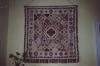
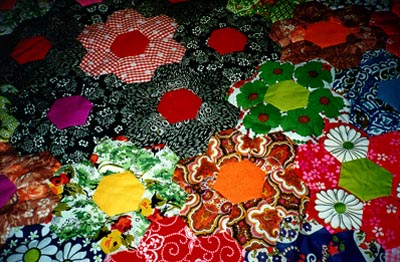
All cotton hexagon quilt using a wide variety of colours and patterns. The hexagons were hand stitched by Sylvia Schleibs in the same style she and her daughter, Norma Gilchrist, had previously made 3 hexagon quilts. There is a calico border and backing.
2000 x 1450mm
History: 

This quilt was part made by Sylvia Schleibs in the Temora district NSW in the 1960s. In 1981 Sylvia's daughter, Norma Gilchrist, gave the hexagons to the Temora Rural Museum and in 1996 Marj Brown (the curator) completed the quilt by stitching the hexagons together and adding a calico border and backing.

Story: 

Sylvia Schleibs was a typical farmer's wife with many interests and commitments including milking the cows and tending a large flock of chooks. She sold butter and eggs and violets, sewed, was a good cook and was practical and thrifty. She and Norma (daughter) only made hexagon quilts.
Marj Brown grew up on a farm and also married a farmer. Her interest in needlework was a great help to her in making her own and the children's clothes. She retired to Temora in 1982 where she became interested in the Rural Museum and became curator in September 1995. Her knowledge of needlework was a great help to her in repairing and finishing articles that were in storage. She likes doing tatting, crochet, knitting and embroidery of all types.

Related Quilts:
National Gallery of Australia
"This is not a true quilt, but a pieced coverlet with a lining. The entire front face of the quilt is of pieced hexagonal and part hexagonal printed cotton patches. Pieces are joined with hand sewn over casting stitches of many different coloured cotton threads. The joining of the patches forms a 'daisy' pattern in some areas and in others it is random. The edge of the front face of the quilt carries a 40mm strip of cotton Chinoiserie which is then folded to the reverse of the quilt and becomes part of the lining. The template for the hexagon patches remains in many of the patches: writing paper and news print." [NGA]
The work is not padded "The lining at the edge of the quilt (for approx.175mm) is a plain weave fabric of a Chinoiserie design. The centre field of the lining is a rectangular panel of a twill weave brushed cotton fabric with a striped floral design." [NGA] 2215 x 2070mm
Diana Cameron
Square quilt top. Floral centre piece with borders of squares set in a diamond pattern. Squares are in plain colours and patterns. There is no padding or backing.
920 x 920mm
Ida Blenkiron
Rectangular quilt with front and back made of rectangles of cotton samples of shirt materials, in checks, stripes and plains. Colours are soft muted reds, greens, blues, yellows and browns, and pastels. Construction is 3 to 4 rows of rectangles joined across the quilt. Padding is probably an old blanket. There is a row of hand quilting approximately the width of one patch in from the edge, holding the layers together.
1870 x 950mm
Pioneer Settlement Authority
Cot quilt of cotton hexagons. There is a central diamond of hexagons and then a repeat diamond motif radiating to the edge. Each hexagon is 40mm. The backing is sheeting or similar and the padding is dacron type.
1200 x 700mm
Annette Gero
Quilt made from furnishing materials some with mettalic flecks. It is machine sewn.
160 x 135mm
The Pioneer Women's Hut
Continuous 'sleeve' of hand sewn small hexagons, many woollen, some joined, some darned, plain and patterned. Several bands of plain coloured hexagons. The padding is ticking, an old cream blanket and part of a bedspread.
1960 x 800mm