Quilt No.631PWH - The Pioneer Women's Hut
The Pioneer Women's Hut
Owner: 
The Pioneer Women's Hut
Location: 
NSW Riverina
Maker
Maker: 
Elsie Shepherd
Made in
AUSTRALIA NSW
Date: 
1941 - 1970
Description: 
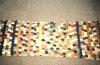
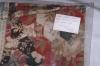
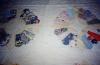
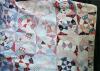
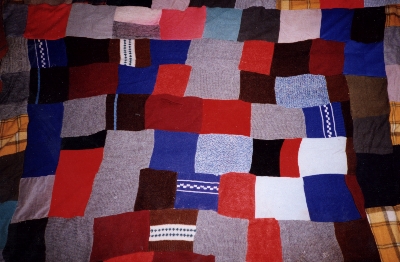
Double sided patchwork quilt. Machined squares and rectangles joined in strips and then the strips joined. Wide variety of materials, mainly woollen from hand or machine knitted jumpers, many patched. All materials came from worn garments from family and friends of the maker. No padding.
1860 x 1410mm
History: 

This is typical of the many quilts made by Elsie Shephard of Rosewood NSW over a 20 year period from 1957 for use in her home. Elsie donated it to The Pioneer Women's Hut. It is displayed occasionally in the museum.

Story: 

"Patch Work Rugs
When my husband was seriously hurt in a road accident in 1956 he was in hospital for a year then another two years recovering until he was fit enough to get a permanent job. There were no Government handouts to needy families then so you had to do your best to balance the budget and make ends meet.
Having a young family people were very kind to me, giving me clothes for my children their children had grown out of that were in good order, some were slightly worn and needed patching.
When my husband had a permanent job people still gave me clothing because I had six children, even though I could afford to buy clothes for them. Because of their kindness I could never say 'no'. I would thank them saying 'nothing will be wasted, I'll make use of what you have given me'.
Being so cold at Rosewood I decided to make patch work rugs for all my children's beds out of garments I knew would never be worn, keeping my word 'I'll make use of what you have given me'.
There was no design or pattern in anything I made, I just kept cutting things up into squares, then stitching the squares together into rows, then sewing the rows together. Whatever colour was in the bobbin I sewed with. I never lined the rugs as I had always sewn enough squares together to just fold the sewn rows over and have the rug doubled. I made some rugs for my husband to take camping.
My eldest daughter slept in the coldest room ub the house. One night I finished her rug, put a lining in it and put it on her bed when she was asleep. It was that heavy that during the night she woke up thinking an animal was on top of her bed! I took the lining out."
[Elsie Shephard, Rosewood NSW 1.4.2000]

Related Quilts:
National Gallery of Australia
"This quilt follows the traditional hexagon patchwork pieced pattern, which are then joined and sometimes edged with a contrasting border. The edges of the quilt have been turned and then scalloped edges made of identical patches to the main body of the quilt have been attached to the edge. The quilt is fully lined, and the lining is visible front the front face through the gaps between the scalloped edge. The lining is attached to the patchwork with a row of stitches along the edges; there are no stitches in the centre field. The fabrics of the quilt are plain weave cotton in simple floral and geometric designs. Most of the fabrics are monochromatic. Several different colour ways of the same fabric are evident which could suggest some fabrics were from manufacturer samples. The lining is a William Morris print.
Each of the patchwork pieces (there are several thousand present) are sewn together with very fine overcasting stitches. The quilt is entirely hand sewn. There is some evidence that templates from the hexagon pieces possibly blotting paper, remain in situ���The quilt is not padded or quilted. The lining is fine twill weave cotton printed in pink and pale purple. The design follows William Morris's 'Strawberry Thief design'." [NGA] 2075 x 1911mm
Wangaratta Historical Society
9 large blocks of crazy patchwork in silks and velvets. The blocks are divided by strips of deep ruby coloured silk. There is a wide ruby border with peaks to which is attached cream lace. The backing is beige silk. The main blocks are outlined with feather stitch in gold thread and many individual patches are outlined in fancy stitches and have embroidered motifs some of which are Australian eg centre patch has Sturt's Desert Pea flowers, parrots, wattle. There are also English flowers, Japanese motifs, flags, domestic objects and Marianne's initials. Embroidery is in a variety of threads including chenille.
2250 x 2180mm
Albury Regional Museum
Patchwork cot quilt, machine pieced, rectangular, 5 x 4 squares. Assorted fabrics including seersucker, corduroy, printed and plain cottons. White ric-rac braid and zigzag machine stitching accentuate rows. Edge of white cotton tape. Backing is single flour bag, calico, with maker's printing visible through patchwork: 'Tiger. Best Australian Roller Flour. Mala Foot. Sole Supply. Part of Kuala Lumper' and Chinese characters.
674 x 540mm
Irma Whitford
Pieced repeat block in 'Dresden Plate' pattern in a variety of fabrics with pink and pale blue predominating. Scalloped outer edge. Machine pieced and hand quilted, with echo quilting of four petals between the 'Dresden Plates'. The padding is polyester, and the backing is white calico. 2600 x 1630 mm.
Mare Carter
Patchwork quilt, all cotton including cotton filling. Pink and white. Large plain pink blocks with white pieced blocks in between in arrow type pattern based on rectangles. Hand sewn and hand quilted
1931 x 1728mm
Gwen Cordinglay
Patchwork quilt made from hexagon patches in silks and rayons, in pinks, blues, red, yellow mainly, with pastels. No padding. Bordered and backed with green satin.
1829 x 1372mm