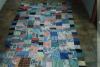
Quilt No.177EQ - Janette McInnes

Janette McInnes
Owner: 
Janette McInnes
Location: 
VIC Melbourne
Maker
Maker: 
Elizabeth Perry
Made in
AUSTRALIA VIC
Date: 
1921 - 1940
Description: 
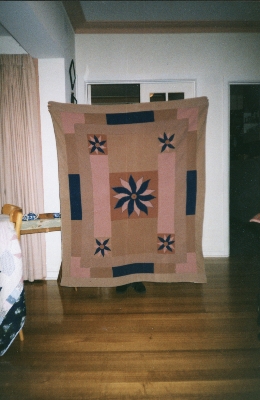
Pieced and appliqued quilt of pink, blue and brown wool. Centre motif is an applique whirligig or flower in pink and blue on tan, with two pink side borders topped by smaller appliqued whirligigs or flowers in the same colours. The outer frame is made of strips of pink, blue,and brown, with a border of brown. Some silk embroidery on the applique edges. No padding. Backing is of cretonne.
1423 x 1144mm
History: 

Made by Elizabeth Perry, at Brunswick (VIC), probably during the Depression. Given to an Op Shop by Elizabeth's niece, Mrs Beryl Chalmers. Now owned by Essendon Quilters Inc.

Story: 

"The quilt was donated to Essendon Quilters. It had been bought at an op shop for $2.00. I had become very interested in the quilt and after a bit of research found the person who gave it to the op shop. That was Mrs Chalmers. Beryl Chalmers remembers the quilts (there was another) when the family lived in Brunswick (Vic) and feels they were made for a move the family made to Hampton.
Later on the quilts were used at a beach house at Lorne and withstood a lot of hard work. Although the quilt is quite small by our standards today it was made for a single bed.
Elizabeth Perry was born around 1895 and died in 1975. Her niece remembers her as a remarkable lady being able to produce fine hand work or turn to heavy work such as crocheting etc. She was a great seamstress and also did fancy work and made baby clothes as well."

Letter from Janette McInnes, 1997:
"Elizabeth Perry never married and lived with her parents until they died. The qult was made in Brunswick where the family lived at 8 Barrow St, brunswick. The family moved to Hampton about this time - 60 years ago. Mrs Chalmers feels that the quilt was made to be used in their new home.
Elizabeth Perry worked at the Commonwealth Clothing Factory during World War I and Mrs Chalmers thinks she continued working after that but doesn't know where. She seems to have worked as a machinist or perhaps hand tailoring? Mrs Chalmers remembers her as a very talented sewer, who also crocheted, made beautiful baby clothes and did fine hand work.
She doesn't remember her grandmother sewing and her own mother did sew but didn't have the skills that Elizabeth had. �"
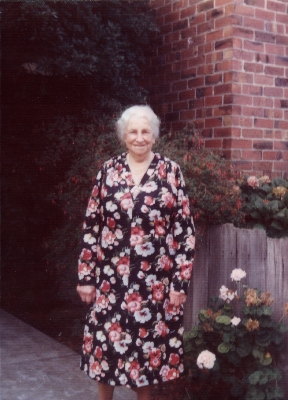
Elizabeth Perry, 1975

Related Quilts:

Margery Smith
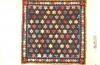
Patchwork cot quilt made from hexagons 63mm across in a variety of cotton prints and plains. The bright coloured patches came from children's clothes and dressmaking scraps. No padding. Backing of unbleached calico. Hand sewn.
1524 x 1169mm
The Queensland Women's Historical Assoc.
Cotton quilt , octagons of printed floral joined with squares of printed and plain. Yellow floral border. Cotton backing with very intrictae pattern in machine stitching.
2540 x 2490mm
Eileen Dinning
Quilt of over 6000 suffolk puffs (also called yo yos) in a mix of cotton and synthetic materials. The top is hand stitched on to a satin backing.
2413 x 1626mm
The Embroiderers' Guild of S.A.Inc Museum
Yellow and white cotton Durham quilt with centre panel of patchwork blocks in counterchange design called 'Plate'. There is a wide yellow border and square white corner blocks. It is padded and there is a yellow backing. It is quilted all over following the patchwork pattern in the centre panel. Feather pattern border.
2120 x 1720mm
Art Gallery of South Australia
Patchwork quilt in the Tumbling Block pattern in light and dark silks in bright colours. On both sides and at the bottom is a wide border in Tumbling Blocks, the pattern vertical at the sides and forming a triangle centre bottom, with an edge on both sides of two black bands with pieced diamonds between. Made for a poster bed. Hand sewn.
1790 x 1750mm
Robyn Gallaway
Machine made cotton quilt with 100mm cotton squares placed diagonally with peaks running around the edge. The colours are mainly autiumn tones and the patterns include checks, tartans, florals, geometric and plains. Materials were scraps left over from sewing projects such as children's clothes. There is a matching valance.