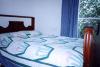
Quilt No.75HAS - Friends of the Hawkesbury Art Society
Friends of the Hawkesbury Art Society
Owner: 
Friends of the Hawkesbury Art Society
Location: 
NSW Sydney
Maker
Maker: 
Sophia Wilbow
Made in
AUSTRALIA NSW
Date: 
pre 1850
Description: 
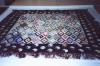
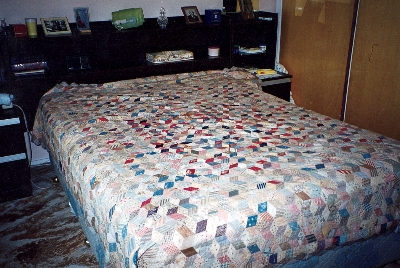
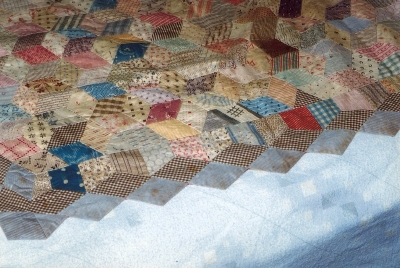
Patchwork Quilt consisting of diamond shapes forming a Tumbling Block pattern. All cotton, mainly patterned pieces, with signs of blotting paper templates. Hand sewn. The outer border of patches consists of off-cuts from nurses' uniforms of the times as 2 of the maker's daughters were nurses. It is thought most other squares were probably from material samples from large city stores such as Anthony Horderns. Backing is red cotton in a paisley design.
2030 x 1890mm
History: 

The quilt was made by Sophia Mary Wilbow (1829 - 1924) in the Windsor district of NSW between 1890 and 1896 and passed by maternal descent to her great grand-daughter. Sophia gave birth to 14 children 9 of whom were girls. She made a patchwork quilt for each daughter and this one was made for Grace. Grace never married and after the death of her younger sister Jane the quilt passed to Victoria who was the only daughter of Louisa (third daughter of Sophia). Victoria married Austin Gruber and they had one child, Joyce (later Hedges) who inherited the quilt after her Mother died in 1962.
In 1998 Joyce Hedges donated the quilt to the Hawkesnury Art Society

Story: 

Sophia M. Wilbow was born in 1829 at Pitt Town NSW to William Henry Payton and his wife Mary, nee Ward. Mary Payton died in 1837 aged 27 when Sophia, the eldest,was still a child. Sophia married Thomas Mitchell Wilbow in 1846 and she gave birth to 14 children, 9 of whom were girls. One was very retarded and one died when young. Sophia and Thomas lived in the Windsor district (near Sydney) where Thomas was a farmer and hotelier.
"Sophia was a great needlewoman, and did embroidery as well as plain sewing, and never used a sewing machine. She made a patchwork quilt for all of her daughters���the last quilt she made was for her youngest daughter Jane and it was 'special'. It was the only one she made with the hexagon pieces, each piece being only the size of a 10 cent piece�." This quilt has over 7000 pieces and in 1991 Joyce Hedges (great grand-daughter of the maker) donated it to the National Gallery. Another of Sophia's quilts, the one made for Elizabeth b.1866, is part of the collection of the Yass and District Historical Society Inc.
After Sophia Wilbow's death in 1924, aged 95, two of her unmarried daughters, Grace and Jane, lived on in their home "Colmier", 17 Dalhousie Street, Haberfield, Sydney.
In 1998 Joyce Hedges donated this quilt of Sophia's to the Hawkesbury Art Society at Windsor NSW.
[Family information from Joyce Hedges 27.3.97]
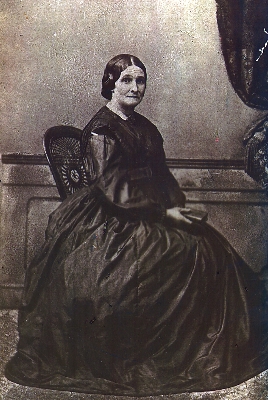
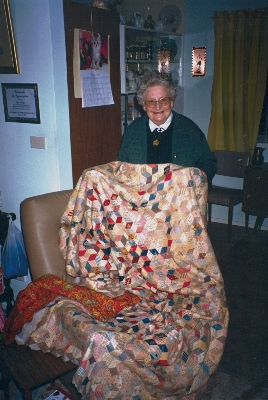
Sophia Mary Wilbow
Sophia Mary Wilbow
Joyce Hedges, great grand-daughter of Sophia 1998

Related Quilts:

Muriel Hartmann
Reused parts of hand knitted woollen jumpers patched together. Wide crocheted edge from wool unravelled from jumpers retrieved from the tip.
1905 x 1525mm
N.S.W. Parks and Wildlife Service
Double sided quilt. Side 1 has an off centre frame based on a hexagon and including triangles and squares in a concentric pattern. The borders are all small rectangles with a single strip of large rectangles at one end. Side 2 has a central patch of pieced shapes appliqued to the background. The borders are squares and rectangles many in striped shirting cotton. Side 1 has minimal quilting to the interlining but it does not go through to side 2. The padding is a thin sheet.
The circle (sometimes pieced hexagons) is common to other 'Craigmoor' quilts.

1450 x 1230mm
The Pioneer Women's Hut
Double sided utility quilt made from machine pieced squares of tailors' samples and men's and boy's suitings. The padding is 5 or 6 layers of pieced used clothing including darned, threadbare socks, part jumpers, blanket pieces etc.
2090 x 1340mm
Gillian Sullivan
Quilt made of 9120 very small Suffolk Puffs, each one about the size of a 20 cent piece. "Each piece backed and the front of it drawn up like a reticule. It was not backed and was rather fragile, so I backed it on to a sheet, as it was heavy and in danger of tearing when lifted." [Gillian Sullivan]
2360 x 2230 mm
National Gallery of Australia
" A wide range of cotton fabrics have been used to make this quilt in the traditional log cabin style. The strips of the log cabin are joined by rows being hand sewn onto a small square backing fabric, each square of strips has then been hand sewn together to form the quilt. The work is backed with a sateen printed fabric decorated with paisley design. A strip of the lining trims the edge of the front face of the quilt. The lining is attached with machine stitching. There are numerous tacking stitches that remain in the front face of the quilt. There are approx 9000 pieces in the quilt, most being only 5mm in width.
The quilt is of three layers because the strips of the log cabin are attached to a backing piece, and then the quilt is lined; however it is not padded." [NGA]
Christine Barnes
Cotton quilt with rosettes of hexagons. There is a centre hexagon with a surround of 6 hexagons in a contrasting pattern and then an outer row of 12 hexagons in a different pattern. Between each rosette is a single row of hexagons in a print common to the whole quilt. The materials are typical of the 60s period. There is a deep aqua border. It is machine quilted. The backing is cotton.
2515 x 1829mm