
Quilt No.395MO - Meg Orr
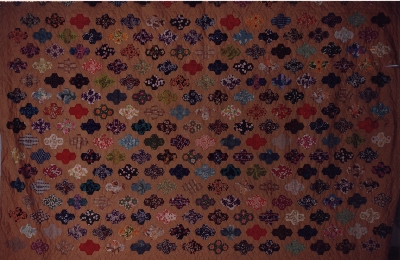
Description:
All over pattern of rows of hexagons with each unit made up of 4 hexagons each 45mm. Patterned and plain materials thought to date from the 1930s including cotton and linen dress materials, synthetics and synthetic crepe. It was an unfinished top and Meg Orr, the present owner, finished it by machine stitching some of the hexagon rosettes to the red twill background and stitching on a backing. There is no padding.
1740 x 1210mm.
1740 x 1210mm.
History:
The quilt was made by Sarah Edith Smith prior to 1942-3 in Sydney. It then passed to the present owner, Meg Orr.
Story:
Sarah Edith Smith (1896 - 1974) lived in Randwick, Sydney when first married but then moved to Vaucluse. She was taught to quilt by her mother Mrs. Stewart. Mrs Smith was a painter until she married and also a national ice skater. She gave up quilting when the war started and became very involved with the Red Cross especially making many things for soldiers.
Related Quilts:
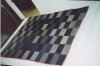
Machine sewn reversible quilt. Side 1 is rectangles of men's suiting samples in mainly grey, navy and black, stripes and self patterns. Side 2 is men's suiting samples but also includes woollen rectangular pieces in plain blue and deep pink. There is a hand sewn binding of fine orange-brown wool. The padding is hessian and cotton.
1460 x 1100mm
1460 x 1100mm
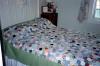
Quilt in a wide variety of patterned and plain hexagons in cotton with a wide green border. There is no padding and the backing is cotton.
2500 x 2200mm
2500 x 2200mm
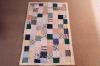
The quilt's construction is cotton patches about 170mm square joined in strips and then the strips joined. The border and backing are pale lemon coloured cotton lawn. The padding is an old woollen blanket. There is ric-rac braid around the border of the top.
2180 x 1420mm
2180 x 1420mm
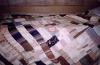
Crazy patchwork on to foundation material with the edges of the pieces turned under and machined. It is not quilted. A 25mm red binding has been machined on. There is no padding. The backing is red wholecloth cotton.
1940 x 1540mm
1940 x 1540mm
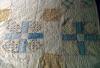
Patchwork quilt, all cotton including cotton padding. Pattern is based on squares and a cross. Variety of fabrics, plain and patterned. Hand stitched and quilted.
2083 x 1626mm
2083 x 1626mm
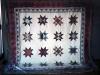
Repeat block in Ohio star pattern. Wide border of triangles, pieced blocks and stripes. Stars are in greens, pinks, mauves (all now very faded) and white. Wreath quilting in squares with smaller wreath quilting in triangles. There is padding and the backing is a poly/cotton sheet. 2500 x 2450mm