Quilt No.905CFM - Carbethan Folk Museum
Carbethan Folk Museum
Owner: 
Carbethan Folk Museum
Location: 
QLD South West
Maker
Maker: 
Ellen Smith
Made in
AUSTRALIA SA
Date: 
1881 - 1900
Description: 
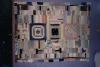
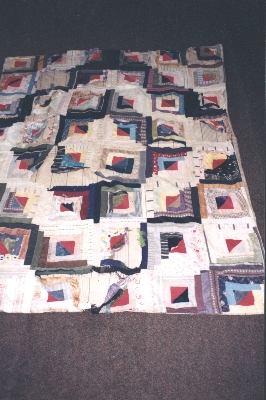
Patchwork quilt in a variation of Log Cabin. The materials are cotton and cotton velveteen. The backing is twill cotton ticking. There is no padding.
1499 x 1169mm.
History: 

Ellen Smith made the quilt at Nairne South Australia probably about the turn of the century. The family moved from Nairne to Crows Nest in Queensland. Fred Smith, Ellen's son, went to SA to visit his family and brought the quilt back in the 1930s. Fred gave it to his daughter Beryl Deeth (Smith) who donated it to the Carbethan Folk Museum at Crows Nest Queensland.

Story: 

"Ellen [Haines] arrived from England on her 17th birthday, the 8th May 1850, on the 'Lysander'. She later married the bullock driver who transported her from port Adelaide to her brother (Perc)'s place at Nairne. They arrived at 2 a.m. in the morning and Ellen's sister in law just moved over in her bed to make room for her that night. She and Mr Hillman [her first husband] had a son who died, and is buried near the forked gum tree in Nairn cemeteery and Mr. Hillman also died from injuries received in an accident, and is buried in the Hillman vault in Nainre cemetery." [Extract Geneology of John Smith by Dawn Foote]
Edis Smith was born in 1827 in England and arrived at Port Adelaide on the 'Star Queen' in 1854. He and Ellen Hillman were married in 1857 and they had twelve children: Emily, Mary Sophia, Rebecca, Zilla, Frederick, Rosina, Hephzibah, Elizabeth Amy, Isabella Annie, Albert Edis, Martha, Herbert Edis. It is said Ellen made a quilt for each daughter.
Ellen was a deeply pious woman and with Edis (a lay preacher for 50 years) helped build the Nairne Wesleyan Church. She died in 1916 aged 83. [Source of information, geneology of John Smith]
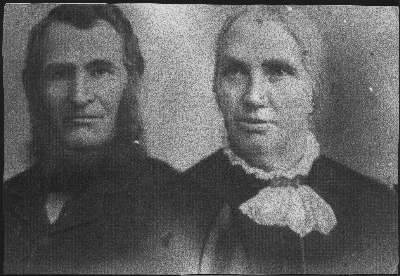
Edis and Ellen Smith

Related Quilts:

National Trust of Australia (NSW)
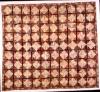
Handsewn quilt of hexagon patches in cotton prints in 'Grandmother's Flower Garden' pattern. Each flower consists of double rows of print hexagons around a yellow centre and these are joined by 'paths' in plain green and white cotton. Backing is green cotton and there is a wool padding. There is outline quilting around all green and white hexagons and centre and first row of hexagons in flowers.
1885 x 1750mm
Mary Robertson
The suffolk puffs are mainly cotton in a wide variety of colours and plain and patterned materials. The puffs are small squares rather than the more usual circles. The backing is teal satin hand stitched to the top. There is a teal bow at one end. There is no padding.
1570 x 1100mm
Darla Taylor
Double sided patchwork quilt. Both sides have central frame surrounded by borders. Side 1 has diamond of squares set in a square frame 490mm. Borders are squares and triangles. Side 2 is central frame of squares on point surrounded by plain grey velvet border then marroon border. Materials are cottons, silks, velvet, crepe, rayons in a wide variety of colours and apperned and plain. Machine construction. No quilting. Padding is a cream wool blanket.
1440 x 1420mm
La Dona Anick
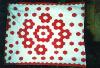
Red and white cross stitch quilt. Central white panel with red cross stitch embroidery featuring flowers and leaves. Red panels as borders with white embroidery, also flowers and leaves. Machine pieced. Hand quilted in an espalier pattern. There is a fine padding and the backing is homespun. 2200 x 1970mm
National Trust of Australia (TAS)
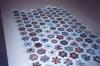
Quilt top of hexagonal patches in silk and velvet in colours of brown, black, soft green, maroon, light yellow and blue. Some materials self patterned. Blue backing papers can be seen at edges behind some patches.
National Gallery of Australia
" Reversible patchwork quilt of woollen suiting in grey, blue, navy, maroon and brown. The fabrics appear to be new tailor's sample pieces (the sizing is still present on the fabric, signifying it has never been washed). The patches are rectangular and vary in size. Both sides have different designs. The front of the quilt has 4 rows of 12 vertical rectangles then below this are 4 rows of 7 horizontal rectangles followed below by 4 rows of 11 vertical rectangles. The reverse of the quilt has a section at the top and bottom composed of 5 rows of 9 horizontal rectangles. The central area is made up of a centre section of 6 rows of 5 vertical rectangles; flanked on either side by a column of 10 horizontal rectangles and two columns of 8 smaller vertical rectangles.
The patchwork layers are joined at the edges with machine stitching. The patchwork layers and padding are machine quilted on the front down 2 vertical lines following joins in the patchwork; therefore not being totally straight. The lines are more noticeable on the reverse as the 2 sides do not match. The front face is displayed at the NGA.
Between the patchwork layers is a striped cotton blanket in black, sky blue, white and cream." [NGA]
2082 x 1386mm