Quilt No.1025JL - Joyce Lannin

Joyce Lannin
Owner: 
Joyce Lannin
Location: 
WA Country
Maker
Maker: 
Joyce Lannin
Made in
AUSTRALIA WA
Date: 
1941 - 1970
Description: 
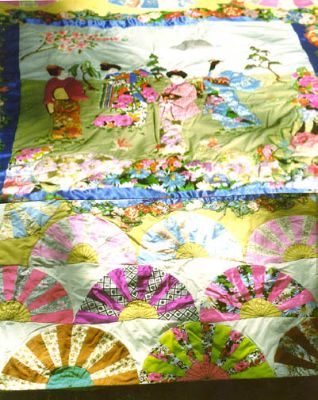
Handsewn quilt with central appliqué scene of Japanese women and Mt. Fuji. Appliqué flowers form a border around the centre panel and three rows of open fans a second border. Each fan is different. The padding is cotton and the backing is polyester sheeting with a border of fans. 2380 x 2355 mm
History: 

The quilt was made by Joyce Lydia Lannin (born Harvey 1918) at Lake Grace, Western Australia in the 1950s. It is still owned by Joyce and is used.

Story: 

Joyce Lydia Lannin. "As long as she can remember Joyce has had an interest in sewing. As a small child she sat and watched her mother sewing at the machine or doing fancy work by hand so it is not surprising that she soon had a needle and cotton in her hands
When her mother began doing patchwork it was no wonder that Joyce took an interest in that too. From her mother she obtained her first hexagon template and was soon spending all her spare time sewing medallions together to make her first quilt. She worked the medallions in patterns as the ideas came into her head with the result that the quilt is very beautiful. At this time there were no books as it was before patchwork became popular.
After completing the first quilt Joyce decided to make a quilt for each of her four granddaughters. These quilts were made with large patches forming stars in the colours of their bedrooms. They are all different as the patches are arranged differently and thus each has its own appearance."
�������.."Joyce has only made her quilts from patches she has in her scrap box. They have all been made by hand and sewn by hand. The backs are all made from sheets with a row of patchwork flowers at the edge." [Joyce Lydia Lannin]

Related Quilts:
National Trust of Australia (WA)
Silk and velvet frame quilt with centre patchwork block of squares and triangles with a top and bottom border of silk in Royal Stewart tartan. This rectangular centre frame is surrounded by plain and 'saw tooth' (triangles) borders. The outer border is dark grey silk embroidered in pastels in stem stitch in a meandering vine and leaf pattern. There is no padding or quilting. Backing originally of mustard wool material machine stitched along turned in edges. Dark red cotton is attached to original backing.
2015 x 1320mm
Fleur Margaret Lehane
Unfinished cotton frame quilt. The centre square is 4 triangles and this is surrounded by a border of smaller triangles. Most of the other borders are of triangles in a wide variety of materials, printed and plain.
2286 x 1829mm
The Pioneer Women's Hut
Machine pieced cot quilt made from squares of material including tweed, wool, blanket and pyjama material. The squares are joined in rows with colours randomly placed. There is a pink satin edging. The backing is part of a pale pink blanket.
1150 x 900mm
National Trust of Australia (VIC)
Double sided patchwork quilt. One side has small 'Tumbling Block' pattern. The other side has larger pattern of pieced stars. It is made of silks, some printed, some solid colours mainly blues, greens cream and black. There is no padding.
2100 x 1800mm
June Johnson
Hand sewn cotton cot quilt with pattern of red and white lozenge shaped hexagons measuring approximately 65mm from top to bottom. A centre flower is constructed from 2 circles of 19 hexagons in red and white. This is surrounded by 8 smaller hexagon flowers. Additional single red hexagons are scattered at random on the white background around the rows of flowers. The quilt is not quilted or tied but is attached at all 4 edges. Writing on the back of the quilt (probably added later) reads "Made by Sarah Hodge, Newport, Wales UK for her first child John." There is no padding and the backing is white cotton. 1000 x 1250 mm.
National Trust of Australia (SA)
Randomly patched quilt in many different colours and fabrics. There are appliquéd shapes over many pieces including Suffolk Puffs, hearts, hexagons and other shapes. There is an embroidered inscription "A11 to S11 1829" which is thought to mean AN to SN 1829. There is no padding and the backing is white cotton.
2000 x 2200mm