Quilt No.333GM - Gundagai Historical Museum
Gundagai Historical Museum
Owner: 
Gundagai Historical Museum
Location: 
NSW Riverina
Maker
Maker: 
Mary Mclean
Made in
AUSTRALIA NSW
Date: 
1941 - 1970
Description: 
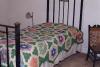
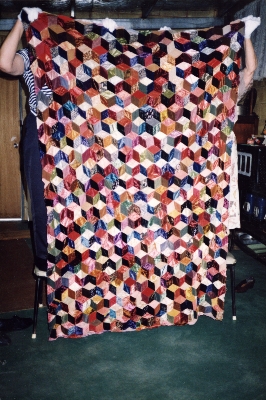
Patchwork quilt made of diamond patches in the Tumbling Block pattern. Fabrics used are velvet, corduroy, brocade, crepe, with dark bright colours predominating, also cream and pastels. Each patch is lined or backed with various fabrics such as crepe or lining fabric. Hand and machine sewn.
2070 x 1500mm
History: 

Made in the 1940s by Mary McLean (1877 - 1971) of 'Big Ben', Gundagai (NSW). Previously owned by Mary McLean. Now owned by the Gundagai Museum.

Story: 

" Miss Mary McLean of 'Big Ben' died on Friday morning, severing a link with Gundagai's pioneering past.
She was 94 years of age.
The late Miss McLean was the last survivor of one of Gundagai's great pioneering families. She lived all her life in this district, and at the time of her death was still residing at 'Big Ben' at Willie Ploma.
Truly a grand old lady, Miss McLean loved to tell the tales of the early days in this district.
Declining health in the last years kept her out of the public eye, but for many years she had given the people of this district a sterling example of citizenship. The late Miss McLean was a daughter of one of the old teamsters, Johnnie McLean, who used to drive bullock teams from Sydney to Gundagai before the railway had reached out.
In the year 1884 he and another teamster Jack Story, loaded at Pyrmont the cylinders which are in Prince Alfred Bridge, Gundagai.
When John McLean first [?] on Big Ben Creek, he gave it the name from a shepherd known as Big Ben, who was shepherding sheep in the area.
Mary McLean was born at her parents' home, 'Stonefield', on Big Ben Creek on February 2, 1877. She lived on Big Ben Creek all her life.
Her father, John McLean, was one of the pioneer farmers of this district, cultivating some areas, but concentrating mainly on cattle raising.
Upon his death in 1927, Miss McLean and her sister Isabella commenced dairying.
Her main interests included the Red Cross Society for whom she was a tireless worker. Her handwork, knitting and crocheting, was much in demand. A staunch member of the Presbyterian Church, Miss McLean was organist at St David's Church, Gundagai, for many years.
Particular interests she held were in the Burnside presbyterian Homes at Carlingford and the Australian-Inland Mission.
A keen gardener, Miss McLean built the present home on Big Ben in 1931 and planned and built the gardens herself. She was an avid reader and had an active interest in all activities associated with rural development.
Always interested in world events, Miss McLean had one of the first radios seen in this district, a wet battery set.
Her great interest was in her family, and Big Ben was the holiday home for all her nieces and nephews. During school holidays Big Ben was inundatd with children.
A brother and sister survive Miss McLean. They are John (Mirool) and Isabella (Sydney).
Miss McLean had twenty-one nieces and nephews, 39 grand nieces and nephews and 34 great grand nieces and nephews. �"
[Obituary from the Gundagai Times, 1971.]

Related Quilts:

Valinda Gale
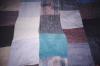
Patchwork quilt made from squares of cotton prints in florals, stripes, spots and checks, joined together in rows. Colours are predominantly blues, reds, yellow and pastels. Binding is of turquoise blue fabric. Materials appear to be from the 40s or 50s. Patches caught in the middle with a woollen knot - red, yellow, blue wool. No quilting. Backed in blue fleecy flannel.
Single bed length and width.
Barbara McCabe
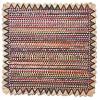
"A single bed cover made up of squares and recrangles of woollen fabric pieced together by a Vicker Sewing Machine from Myer Melbourne. The fabrics are either new (left over scraps) or used (unpicked woollen garments). The backing is an old (used) candlewick bedspread. There is no padding. It is faded and worn due to being used for other purposes later. There is a 66 cm high clown that ahs been appliqued on mainly by hand using blanket stitch. It is also made from scraps of fabric. The hands were cut from an old felt hat."
2400mm x 1660mm
National Gallery of Australia
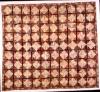
"This quilt follows the traditional hexagon patchwork pieced pattern, which are then joined and sometimes edged with a contrasting border. The edges of the quilt have been turned and then scalloped edges made of identical patches to the main body of the quilt have been attached to the edge. The quilt is fully lined, and the lining is visible front the front face through the gaps between the scalloped edge. The lining is attached to the patchwork with a row of stitches along the edges; there are no stitches in the centre field. The fabrics of the quilt are plain weave cotton in simple floral and geometric designs. Most of the fabrics are monochromatic. Several different colour ways of the same fabric are evident which could suggest some fabrics were from manufacturer samples. The lining is a William Morris print.
Each of the patchwork pieces (there are several thousand present) are sewn together with very fine overcasting stitches. The quilt is entirely hand sewn. There is some evidence that templates from the hexagon pieces possibly blotting paper, remain in situ���The quilt is not padded or quilted. The lining is fine twill weave cotton printed in pink and pale purple. The design follows William Morris's 'Strawberry Thief design'." [NGA] 2075 x 1911mm
Queen Victoria Museum and Art Gallery
Quilt with alternate red and white diamonds in cotton, with wide border of white cotton and a white cotton crochet edging. All diamond patches and edging were joined to white border decorated with feather stitch. White border edged with zig-zag white feather stitch. Centre rectangle of white has 4 red petals edged with white feather stitch and 4 red diamonds each embroidered in white clockwise: '1898', 'R', 'L', 'K'. Diamonds edged with feather stitch. There is no padding and the backing is white cotton.
2420 x 1740mm
Alice Lemon
Patchwork quilt made from hexagon patches on one side, and squares and rectangles on the reverse. Cottons are used, mostly from dressmaking, in bright and light colours. The hexagons form an indented edge on all sides; on the back the rectangles have been cut at the edge to match the hexagon shapes. Hand sewn, the edge machine sewn.
No padding.
1551 x 1373mm
Queen Victoria Museum and Art Gallery
Frame quilt, hand and machine sewn, centre square of squares (7 rows by 7 rows) of 2 triangles, with red border. Alternate rows of triangles, rectangles, 'flying geese' border, squares, squares set on point with triangles, wide red border. Hand quilted throughout in chevrons, single cables and single scallops. The padding is a hand woven cream wool blanket and the backing is cream cotton twill.
2330 x 2030mm