Quilt No.965NGA - National Gallery of Australia
National Gallery of Australia
Owner: 
National Gallery of Australia
Location: 
ACT
Maker
Maker: 
Sophia Wilbow
Made in
AUSTRALIA NSW
Date: 
1881 - 1900
Description: 
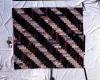
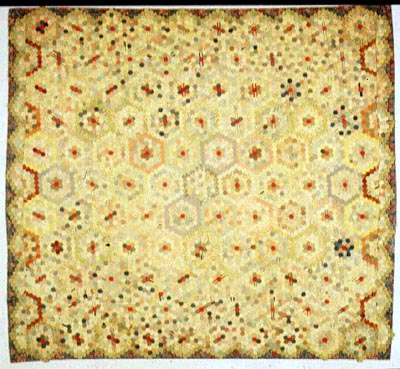
"This quilt follows the traditional hexagon patchwork pieced pattern, which are then joined and sometimes edged with a contrasting border. The edges of the quilt have been turned and then scalloped edges made of identical patches to the main body of the quilt have been attached to the edge. The quilt is fully lined, and the lining is visible front the front face through the gaps between the scalloped edge. The lining is attached to the patchwork with a row of stitches along the edges; there are no stitches in the centre field. The fabrics of the quilt are plain weave cotton in simple...
History: 

The quilt was made by Sophia Mary Wilbow between 1893 and 1896 for her youngest daughter Jane. Jane Wilbow did not marry and upon her death in 1956 the quilt was passed on to a niece, Victoria, who in turn passed it to her daughter Mrs Joyce Hedges, New South Wales. Joyce Hedges donated the quilt to the National Gallery in 1992.

Story: 

"Sophia Mary Wilbow nee Payton (Australia 1829-1924, who was born in Pitt Town near Windsor, made this quilt. Sophia married Thomas Mitchell Wilbow in 1846 and spent most of her life in the Hawkesbury River district where her husband was a farmer and hotelkeeper. She had fourteen children and made a patchwork quilt for each of her seven daughters. This quilt was the last one she made and was given to her youngest daughter Jane. It is believed Sophia worked on the quilt whilst she sat at the side of her dying husband who suffered a long illness prior to his death in 1896." [NGA]

Related Quilts:
Cressida Mary Webb Challis
Quilt of machine pieced squares and rectangles using a wide variety of materials in plain colours and patterns. It is one of a pair. There is no padding and the backing is 90cm strips of calico.
2500 x 2130mm
Fiona Gavens
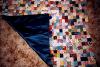
Hexagon quilt constructed over papers; all seams oversewn with featherstitch embroidery. Materials are vyella and clydella scraps from childhood dresses of the maker's first four children, augmented with scraps from a dressmaker and a book of samples. There is no padding; backing is plain, pale blue, brushed cotton.
2200 x 1720 mm.
Teona Smith
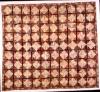
Suffolk Puff or puff-ball quilt is made from scraps of dresses and pyjamas, mainly cottons, but also taffeta lining fabric, net, lurex, flocked organdie. The quilt is in bright clear colours, the fabric mostly in small prints, ginghams, different size spots, a few large prints, Chinese brocade, nylon. Puffs are 5cm across, and set 31 puffs across by 45 down. Puffs are squared off when whipstitched together, so corner holes are smaller than usual.
2180 x 1500mm
Kaniva District Historical Society
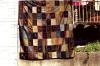
Crazy patchwork quilt, mostly velvet, with two rectangular frames or borders of green fabric. All patchwork pieces have embroidery over the seams, mostly herringbone. Quilt is edged with a cream cotton ruffle. Cotton backing.
1625 x 1625mm
Gillian Sullivan
Quilt made of 9120 very small Suffolk Puffs, each one about the size of a 20 cent piece. "Each piece backed and the front of it drawn up like a reticule. It was not backed and was rather fragile, so I backed it on to a sheet, as it was heavy and in danger of tearing when lifted." [Gillian Sullivan]
2360 x 2230 mm
National Gallery of Australia
" A wide range of cotton fabrics have been used to make this quilt in the traditional log cabin style. The strips of the log cabin are joined by rows being hand sewn onto a small square backing fabric, each square of strips has then been hand sewn together to form the quilt. The work is backed with a sateen printed fabric decorated with paisley design. A strip of the lining trims the edge of the front face of the quilt. The lining is attached with machine stitching. There are numerous tacking stitches that remain in the front face of the quilt. There are approx 9000 pieces in the quilt, most being only 5mm in width.
The quilt is of three layers because the strips of the log cabin are attached to a backing piece, and then the quilt is lined; however it is not padded." [NGA]