Quilt No.346HMS - Harden Murrumburrah Historical Society
Harden Murrumburrah Historical Society
Owner: 
Harden Murrumburrah Historical Society
Location: 
NSW Riverina
Maker
Maker: 
Tamar Borrow
Made in
AUSTRALIA VIC
Date: 
1881 - 1900
Description: 
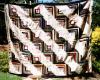
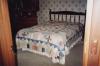
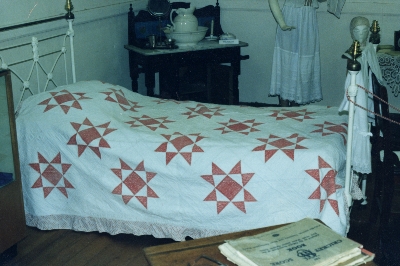
Patchwork quilt has pieced blocks in the 'Ohio star' pattern in red print and white cotton, alternating with plain white blocks. Quilt has a 9cm frill in red and grey geometric print cotton, machine stitched around the edge. Quilt appears to have some hand quilting. No padding. Backing is white cotton.
2210 x 2060mm
History: 

Made during the 1880s by Tamar Borrow (1862-1947), probably at Leongatha, Gippsland Vic. Inherited by her cousin Beatrice Mossop in 1947, and inherited by William Mullett 1965. Owned by the Harden Murrumburrah Historical Society.

Story: 

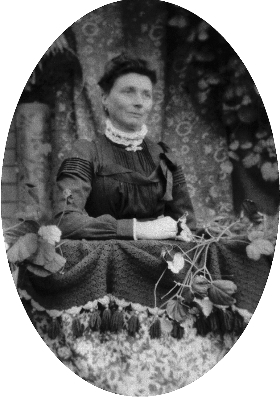
"Tamar was born in 1862, the third child to George Borrow and Mary (Mossop) at Mt Clear just outside of Ballarat, Victoria. She inherited the name from her grandmother, Tamar Taylor.
Tamar had a sister, Jane (1856) and a brother Henry (1859). A younger brother, George (Brother Will) was born in 1865.
She went to school in Buninyong and later lived in Leongatha with her mother and brother, Henry (Harry). Harry moved the family around but while at Bullarto he caught an influenza and died there.
Those remaining bought a house in St Kilda and in an endeavour to keep the family together, all moved in.
Tamar never married and both she and her younger cousin, Annie Beatrice Mary Mossop (Beattie), lived on together until Tamar died in 1947 aged 85.
Tamar's talents were strongly influenced by her mother who was said to be 'very creative'. The family were proud of her.
Much of their work was done by candle and lamp light and a front room of the house was dedicated to this."
[Notes from Harden Murrumburrah Historical Society 1998]
Tamar Borrow
Tamar Borrow

Related Quilts:

Albury Regional Museum
Patchwork quilt or cloth made from pieces of woollen material used for regimental uniforms in England last century. Star pattern in colours, red, pale blue, green, maroon, yellow [white] and brown. Hand pieced probably by more than one person. Red fringe machined on. Red flannelette backing in poor condition. Two layers, not quilted.
1780 x 1700mm
Helen Sparkman
Hexagon quilt made from dressmaking scraps from one neice. The quilt top only is complete and a few papers are still attached.
2250 x 2000mm
Alison Tunney
Quilt in mauve, pale blue and white squares, with wide borders of floral and off white. The quilting is a centre medallion with leaves on the border, and cross hatched over all. The padding is cotton batting, and the backing is plain white cotton. 2180 x 1900 mm.
National Gallery of Australia
"This is not a true quilt, but a pieced coverlet with a lining. The entire front face of the quilt is of pieced hexagonal and part hexagonal printed cotton patches. Pieces are joined with hand sewn over casting stitches of many different coloured cotton threads. The joining of the patches forms a 'daisy' pattern in some areas and in others it is random. The edge of the front face of the quilt carries a 40mm strip of cotton Chinoiserie which is then folded to the reverse of the quilt and becomes part of the lining. The template for the hexagon patches remains in many of the patches: writing paper and news print." [NGA]
The work is not padded "The lining at the edge of the quilt (for approx.175mm) is a plain weave fabric of a Chinoiserie design. The centre field of the lining is a rectangular panel of a twill weave brushed cotton fabric with a striped floral design." [NGA] 2215 x 2070mm
The Pioneer Women's Hut
Cotton quilt in pattern commonly known as "Double Wedding Ring'. Probably an American McCall's pattern. Hand stitched, florals, checks and plain pieces. The backing is pink cotton. Scalloped edge.
2300 x 1880mm
Powerhouse Museum
"A tied patchwork wagga quilt made from swatches of men's wool suiting fabrics in blue/grey and pink/brown tonings. Rectangular swatches have been cut in half diagonally, and the resulting right-angled triangles paired to form larger equilateral triangles which alternate dark with light across the field. The quilt has been machine and hand pieced, then machined in vertical stripes.
The centre field is bounded by two strip-pieced borders at top and bottom, and three down each side. These are sewn from rectangles, using light pink/brown tones for the inner border and darker colours for the outer borders. The quilt is padded and backed and the side seams are secured with black herringbone stitch. The three layers are tied together invisibly with lazy daisy stitches in black cotton from the back." [PHM] The padding is a wool blanket and the backing is two pieces of cream twill cotton.
2030 x 1440mm